Showing posts with label reviews. Show all posts

Wednesday, May 13, 2020

Review: Upload, Season One

Like many people these days, I'm binging shows on Netflix and Amazon. Unlike most people, this has little to do with the Coronavirus lockdown, and more to do with inheriting a smart TV from my sister-in-law. I'm finally getting to see things like El Camino and Jessica Jones, plus a ridiculous number of superhero shows.
When I saw the ads for Upload, I knew I had to watch at least the first episode. The premise: if you have the money, you can have your mind uploaded to an Internet Heaven when you die. I used to spend a lot of spare time in Second Life, and I was getting that vibe from the ads. It was a great idea, and it was up to Greg Daniels to either succeed with it or screw up. 
The show did not disappoint me. Upload is a lot of fun, and I plowed through the season in a matter of days. The longest episode was the first, where the main characters and Lake View (a very tony Internet Heaven) are introduced, and it only lasts forty-five minutes. The rest of the episodes are about twenty-four minutes each. Bing, bing, bing!
Nathan Brown is a computer programmer engaged to Ingrid, a very wealthy and self-absorbed girl. When Nathan is seriously injured in an accident with his self-driving car, Ingrid pushes for him to become an upload to Lake View, where her family plans to spend their afterlives. Nathan accepts.
Lake View is visually based off the grand hotels of the early twentieth century, with virtual bellhops and large rooms where the dead meet and make new friends. The exterior shots taken for the place are from the Mohonk Mountain House, which I'm adding to the list of hotels I'd like to stay in (the Chateau Frontenac and the Grove Park Inn are on the same list). 
Every resident of Lake View has an Angel, someone available 24-7 to answer questions and serve the needs of the well-heeled residents. Nathan's Angel is named Nora, and it's hard not to like her. She and the other Angels work cheek to jowl in a large room with rows of computer screens, and they aren't paid very well. Nora's father is dying of vape lung, and she wants to borrow enough money to get him into Lake View. Unfortunately, Nora's ratings aren't high enough at work (or in the bedroom, which is another story) and her boss is a petty bitch. Her father also wants to go to 'regular' Heaven to be with her mother, which means when he's gone, he's gone. Nora's emotions bleed over into her job, and Nathan, hungry for real interaction, is supportive. She begins to bond with him.
Meanwhile, Nathan has his own problems. Since Ingrid is paying for everything, his existence is dependent on her happiness and whims. She dresses him in kneepants for his own funeral (perhaps she likes calves?) and considers 'pausing' him when she's too busy with other things. He also has some damaged and missing memories, which isn't supposed to happen with the elite service Ingrid is paying for.
Nathan begins puzzling about it, sharing his concerns with the other uploads. I goggled when they introduced his neighbor across the hall - William B. Davis, best known for playing the Cigarette Smoking Man on the X-Files. The character, David Choak (Koch backwards, I presume), is fabulously wealthy and takes an interest in Nathan. He doesn't believe Nathan died in a freak accident; he believes Nathan was murdered. And if CSM says that, you can take it to the bank.
Nora joins Nathan in his quest for the missing memories, risking her approval ratings and even her job. Before the end of the first season, she's also risking her life.
Upload is a great dystopian sci-fi comedy, with hilarious situations and a handle on cultural developments down the road. One of Nathan's new friends is a kid who's been dead for at least a decade, but is still stuck in a child avatar. They sneak off to the virtual black market and the kid buys a puberty upgrade - which doesn't work out the way he planned. When Nora's dad takes a tour of Lake View, technical problems turn Nathan and the horses they're riding on into block figures. Corporate branding is everywhere, including on the leaves of the trees. Pop-up ads appear regularly in public rooms and paths, just like they do on Second Life. Angels promote virtual products, and receive bonuses if their clients buy.  And everyone is given rating stars for their performance in everything, including the bedroom.
I recommend watching the show. It's full of entertainment and a lot faster than reading this review.

Friday, December 06, 2019

Book Review: Pines by Blake Crouch

Pines (Wayward Pines, #1)Pines by Blake Crouch
My rating: 4 of 5 stars

I picked this book up on a recommendation from Crimereads, and was swept up immediately.
I didn't know the genre, didn't know that it was the first of a series, or that it was even on television. The novel begins with a basic thriller lure - Secret Service agent comes to small town in search of missing agents - and plunges deep into dystopia by the end. Ethan Burke, the aforementioned agent, has been injured in a car accident and doesn't even know who he is at the beginning of the book. His memory begins to come back, but he doesn't remember the investigation's details or what he discovered before waking up on the streets of Wayward Pines. I'm a sucker for an amnesiac hero (see Nine Princes in Amber by Roger Zelazny), or a hero who no longer has vital information he needs (also see The Face of a Stranger from Anne Perry), so I ate this up. I also plowed through the book in one evening, because this tale demands commitment.
The town appears, at first, to be cookie-cutter Suburbia with an unhelpful sheriff. There's also the unhelpful hospital, and the unhelpful new receptionist at Ethan's home office who never seems to pass Ethan's urgent telephone messages on to his superior. It goes downhill from there, and soon our hero is on the run, ducking the law and the local angry villagers--er, residents--who throw parties when they're eliminating outliers. The only friendly person he meets is Beverly, a woman who came to Wayward Pines in 1985--and appears not to have aged.
This is not a novel of pretty words; it's one of action. The reader never rests. Ethan is always running, hiding from the residents of Stepford North, or, later, climbing up cliffs. I followed him, leaping from mental crag to mental crag. It's also in Sensesurround: because he's injured, only partially clothed at times, and has no money, he's cold and constantly hungry. I live in Florida, and had to put my slippers on for protection from the imaginary elements. It's a good read, and when you get to the reveal, you will either be excited or disappointed. I was intrigued. I'm not sure I would try the TV series; I already have some very clear mental pictures of the place and the characters. Other books in the series, however, are a definite possibility.

View all my reviews

Tuesday, April 23, 2019

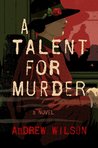
Review: A Talent for Murder by Andrew Wilson

A Talent for MurderA Talent for Murder by Andrew Wilson
My rating: 5 of 5 stars

This is the first novel in a series starring the author Agatha Christie as the main character. Biographer Andrew Wilson spins several well-researched events of 1926 into a gripping tale of why Agatha Christie disappeared for several days, and what happened during that time. He's not the first person to do so - the movie Agatha springs to mind - but Wilson's version grabbed me from early in the book and wouldn't let go.
The book opens with Agatha's despair. Her husband, Archie (played in the film by the swoonworthy Timothy Dalton) has fallen in love with a younger woman and doesn't understand why his wife isn't being reasonable about giving him a divorce. Wilson must have suffered a broken heart at least once; he describes Agatha's pain in convincing detail. Her misery is interrupted when she is pushed into the path of a train, and then 'saved' by a man who is no hero. Dr. Patrick Kurs has been following her exploits for some time, and he believes she should perform a service for him. In exchange for not releasing love letters between her husband and his mistress, he wants Agatha to kill his wife. He will arrange to be elsewhere, and she can put her knowledge of murder to good use. When she balks at his demands, he threatens to harm her family, specifically her daughter. Convince of his ability to hurt them, she agrees.
Kurs only allows her to decide how to commit the murder; the rest of her actions follow a plan he has already devised. First, Agatha disappears into the countryside, abandoning her car and her fur coat for the police to find. She is allowed to keep her purse, which contains a pouch of poisons. He forces her to check into the Swan Hydropathic Hotel under the last name Neele (the name of Archie's mistress) and, later that evening, to dance the Charleston at his command. These have little to do with the crime he wants her to commit; they are designed to humiliate her and reveal how much she is under his control.
We are occasionally given a glimpse into the police investigation of Agatha's disappearance and a separate investigation by a young woman who is also determined to find her, but never for long. The focus always returns to the mental battle between the fiendish Kurs and Agatha Christie, one of the world's cleverest plotters. He humbles her again and again, but she finds an interesting way to give him what he wants.
This book is very well written and researched. Wilson shows us true details of Agatha Christie's life, and uses what is known about her disappearance as the framework for a powerful conflict between two very clever and determined people. I recommend it.

View all my reviews

Wednesday, February 27, 2019

Review: Smoke and Ashes, by Abir Mukherjee

Smoke and Ashes (Sam Wyndham, #3)Smoke and Ashes by Abir Mukherjee
My rating: 4 of 5 stars

"The first drag of the first pipe was a deliverance, like the breaking of a fever. With the second pipe, the shaking stopped, and with the third, the nerves steadied."

Sam Wyndham's error was calling for a fourth. Smoke and Ashes spotlights Wyndham's opium addiction in the first scene--and nearly ends his career with the CID at Lal Bazar, when the vice division raids the Calcutta den he's visiting. During his escape from the authorities, Sam discovers a dying man, curiously mutilated. He continues his flight, but begins a low-key investigation into the murder, which mysteriously appears to remain undiscovered as far as the authorities are concerned.

A more pressing matter is on his superiors' minds - the Indian National Congress and its leader, Mahatma Gandhi. The cause of self-rule have swept the country, with protest rallies, labor strikes, and the burning of British textiles. The Prince of Wales is touring India to restore goodwill and the status quo, and he is coming to Calcutta for Christmas. Alas, there will be no carols about it. One of Gandhi's primary supporters, C.R. Das, is leading the non-cooperation movement in the city, and Lord Taggart is sending Sam and his sergeant, "Surrender-not" Banerjee, to persuade him not to stage protests or stunts during the visit.

Sam Wyndham isn't looking forward to the job:

"I hated this new breed of pacifistic Indian revolutionary. So often they acted like we were all just good friends who happened to disagree about something, and that once the issue was resolved - obviously in their favour - we'd go back to taking tea and being the best of chums. It made punching them in the face morally difficult."

Shortly after their first visit to see Das (fruitless, of course), the second body turns up - mutilated like the man from the opium den.

The Das intervention and murder investigation turn the wheels of the plot after that, taking us into an unsavory part of British history in India, until all the elements come together at the climax of the book, shifting what was a mystery into a thriller.

My greatest pleasure in reading Abir Mukherjee, comes from his use of the language, his ability to slide between cultures, and his philosophical view of his subject matter. His commentary through Sam reminds me a bit of John D. MacDonald's writing.

"Calcutta was a city divided in more ways than one. To the north, there was Black Town, home to the native population; to the south, White Town for the British; and in the middle, a grey, amorphous area full of Chinese, Armenians, Jews, Parsees, Anglo-Indians and anyone else who didn't fit in. There was no law demarking the city, no barriers or walls; the segregation was just one of those things that seemed to have evolved when no one was paying attention."

His observations and seamless writing make the entire series a worthwhile read.

View all my reviews

Friday, February 22, 2019

Review: That Old Scoundrel Death

That Old Scoundrel Death: A Dan Rhodes Mystery (Sheriff Dan Rhodes Mysteries)That Old Scoundrel Death: A Dan Rhodes Mystery by Bill Crider
My rating: 4 of 5 stars

Confession: I haven't read a lot of Bill Crider, unlike most of the literate world. So, I'm reviewing his final Dan Rhodes novel as an outsider looking in.

The book opens with Sheriff Rhodes making what he thinks will be a motorist assist, only to discover that he's stepped into a road rage incident. Kenny is not appreciative of 'Cal Stinson's' driving, and is threatening him with a gun. Rhodes, who appears to always be clear-minded under pressure, subdues Kenny and arrests him.
The next time Rhodes sees 'Cal', the young man has been found dead in an abandoned schoolhouse in Thurston. His true name is Lawrence Gates, and he's not local.

The old schoolhouse is the center of community debate at the moment; some people want it torn down, others want it restored. Rhodes must tangle with the families at the center of the conflict, along with all the other problems Blacklin County can muster. The mayor is angry because a local blog has called him a nincompoop, the local buttinsky Seepy Benton has decided to become a private eye, someone is trying to kill Kenny and Noble (for good reason), and Rhodes' cohorts, Hack and Lawton, constantly complain about being left out of "the loop".
His wife Ivy keeps feeding him kale, which he hates, and he must sneak in his donuts and hamburgers while handling his duties. Meanwhile, reporter Jennifer Loam has reminded him that an election is coming up, and Rhodes isn't sure he wants to run again.

Despite these speed bumps, Rhodes continues his investigation into Gates' death. The closer he gets to the truth, the more he realizes that the schoolhouse issue is just the window dressing for the real issue.

What I enjoyed most in this novel were the gentle humor in the author's voice and how very realistic the characters were. I worked at the reports desk for a police department back in the Stone Ages, and Crider's depiction of Kenny Lambert (a miscreant with a snake tattoo on his neck) and Noble Truelove (badly named) reminds me very much of some of the jokers our officers encountered. The witnesses he interviews are also typical Southerners: they take forever to get to the point, and you're going to learn some history along the way.
Rhodes gets into dangerous situations, but they aren't due to macho behavior or idiocy; they're just things he has to do as sheriff. He also resolves them without loud bravado or action hero moves, something else I respect.

"I want to think that my end will be handled the way I'd like it to be handled. It would be a comfort to me to know that."

The above was from a thought-provoking conversation between Clyde the undertaker and Sheriff Dan Rhodes. Bill Crider was open with his cancer diagnosis, and writing what was likely to be his last Rhodes novel.

I couldn't help but notice the enormous cast of characters in this book, and I discovered that many appeared in previous adventures. He also showed us the new people who took over Hod Barrett's grocery store in Thurston. I couldn't help but think that this was a gift to long-term fans - giving everyone a last glimpse at their favorites, and perhaps concluding a few arcs. He, too, was handling the end the way he wanted it to be handled.

In an afterword, Crider thanks many of the people who helped him along the way in his writing career. He also gives his own opinion on whether Rhodes should run for sheriff again, but I'll leave that for you to discover.

I received a free copy of this novel in exchange for an honest review.


View all my reviews

Sunday, January 06, 2019

Review: Her One Mistake by Heidi Perks

Her One MistakeHer One Mistake by Heidi Perks
My rating: 4 of 5 stars

The novel opens with Charlotte Reynolds preparing to give a statement to the police. It's a device for starting a narrative, but also flags that we can expect to read Something Horrible in the near future.
Thirteen days earlier, Charlotte took her three children to a school fair. She also took little Alice, the daughter of Harriet, her best friend. Harriet was taking Charlotte updates her online status at a critical moment, and Alice disappears. The police are summoned, and the child is nowhere to be found. Harriet and her husband are notified, and Charlotte must endure not only condemnation from the public (her posting on social media becomes public knowledge), but her own guilt for letting her best friend down.
This book kept surprising me. The author and setting are both British, so I expected to plow through a lot of setting the scene and character introduction. The first few pages provide this information, including a bit of tension between Charlotte and ex-husband Tom, but the action--and seeds of doubt--begin early.
Harriet was taking a course in bookkeeping. This is why Charlotte had Alice with her in the first place. This seems very normal, but Brian, Harriet's husband, is surprised. He hadn't been told. Why?
Heidi Perks is an artist at giving out one piece of information at a time, shifting the reader's idea of the truth again and again. Secret after secret is revealed, pulling the reader deeper into the well of mental games, broken relationships, and murder. I kept picking up echoes of Gaslight and Bunny Lake is Missing, and was delighted.
I received a free NetGalley ARC in exchange for an honest review. My honest review is that Her One Mistake is a great read, and I recommend it to readers who enjoy psychological suspense.

View all my reviews

Monday, December 10, 2018

Book Review: A Necessary Evil by Abir Mukherjee

A Necessary Evil (Sam Wyndham, #2)A Necessary Evil by Abir Mukherjee
My rating: 4 of 5 stars

If you've read Kipling or other Victorian stories set in India, this novel contains some of those elements, but it gives you the bad as well as the good. An excellent murder mystery with strong characters of both nationalities and genders.

Plotline in a nutshell: Captain Sam Wyndham and Sergeant 'Surrender-not' Banerjee travel to Sambalpore to solve the murder of an Indian prince. This description, though, doesn't begin to encompass the rest of the story: our entry into a realm where exorbitant opulence and crushing poverty meet, and leaving the relative familiarity of British culture for one less so to an American reader like myself.

I strongly recommend the book.

View all my reviews

Tuesday, September 18, 2018

Review: Dark Tide Rising By Anne Perry (William Monk #24)

Rating: 4 out of 5 stars

View all my reviews

William Monk has changed his profession several times since I began reading the series many, many years ago. Police detective, private detective, investigator for attorneys, etc. His position with the River Police, though, seems to have become his permanent berth. He's settled into the role, assumed the mantle of authority, and formed ties to his men, a change from the alienation he experienced in the early books. Those ties will be challenged in this novel.

Oliver Rathbone contacts Monk on behalf of Harry Exeter. His wife, Kate, has been kidnapped and is being held for ransom. Exeter is willing to pay the ransom, but it requires that he go to a very dangerous area along the river and he wants protection against robbery (en route) and double-crossing during the transfer. Monk accompanies Exeter personally and stations his men in nearby locations to try catching the kidnappers after the safe return of Kate. Instead, the double-cross does happen, and the police are ambushed in their locations.

Kate Exeter is dead, and clearly the kidnappers knew where Monk’s men were going to be. Someone has provided the information to the bad guys, and it could only be someone involved in the exchange. Monk must investigate his own men to clear or condemn them. They all have secrets, and they all have weaknesses… did one knuckle under to blackmail? Worse…bribery?

One of Monk’s men, John Hooper, often takes center stage during this novel. Like Monk, he is agonizing over the idea that they were all betrayed… and, as the secrets of his fellow officers are revealed, it becomes clear that he has one of his own, and it could cost him everything.

As Monk pursues his leads, the trail of crime enters Superintendent Runcorn’s patch. Runcorn, Monk’s old boss and former enemy, develops his own opinions on the case, which don’t always agree with Monk’s. Runcorn charges the husband with murder, and Monk, with Rathbone, work to prove Harry Exeter innocent.

The case ends with a twist I didn’t expect the author to make. It keeps the story from entirely sinking into the tawdry background of Monk’s many cases (since this is the twenty-fourth Monk novel).
I was pleased to see Monk’s men fleshed out further, even under the unpleasant circumstances, and I enjoyed Runcorn’s bold entry into the investigation. Monk’s wife, Hester, does appear in this book, though not frequently enough for my tastes. Scuff, their adopted son, is maturing nicely and has developed ambitions for his future. Beata, Oliver’s new wife, also makes a brief appearance.

Perry often ends the book shortly after revealing the killer; this is one of those occasions. I like a little more denoument, personally, but it wasn't too abrupt. It did remind me a little of a Perry Mason ending, where all is revealed on the stand.

I accessed this novel through NetGalley in exchange for an honest review.


---


Sunday, December 03, 2017

Review: Batwoman Vol. 1: The Many Arms of Death (Rebirth)


Disclosure: I received an advance copy on Netgalley.

In this collection, Batwoman seeks to stop someone who is supplying illegal weapons to the black market, with the stated goal of killing people from as many different nations as possible. Our intrepid heroine follows the trail in her private yacht until it leads to a place she knows well.

This story is more James Bond than superhero. It's also more Harlequin than Harley Quinn.

The art, done by multiple artists, is beautiful. When she wears her costume and her cowl with the long hair, the art reminds me very much of John Romita, Sr. When you see her out of costume, the art is more Sal Buscema. And if you're familiar with those artists, you get an idea of my age and comic-reading background. The action is good, with rough-and-tumble combat that doesn't hold back due to gender. It brought back the best of my memories and granted me a story with a woman in the lead.

The storyline is good. Katherine Kane is every bit the millionaire playgirl that Bruce Wayne is. Unlike Bruce, she tried to serve her country in the military and was tossed out of West Point for being a lesbian during the bad old days. Afterwards, she became a socialite drunkard who was saved by The Batman from leading a useless life. As Batwoman, she traces the bad guys and gals to Coryana, an island of outlaws... and must face her own past.

You will sense a 'but' coming here. If you are worried about spoilers, this might count... but it's not a surprise to the heroine.

This graphic novel involves a lesbian hero, and I believe it was primarily aimed at lesbians. The majority of lesbian fiction I've seen have been romances, and The Many Arms of Death wanders into this category, too. The leading antagonists and allies are all female, and the majority are either former lovers or romantic rivals of Katherine Kane. While romance comics used to be popular, too, this is a little too insular for me. I want to see lesbians interacting with the 'regular' world of comic books, like Maggie Sawyer of Metropolis SCU. Your opinion may be different.

I award this story four stars because I think it's a good storyline, well-executed, and has great art. I would recommend it to those friends who would appreciate it.


Sunday, March 27, 2016

Review: My Big Fat Greek Wedding 2

My family and I loved the original film; my father often said that it bore a strong resemblance to his courtship of my mother, sans the religious conversion to Greek Orthodox. Of course I wanted to see the sequel. Toula's family was wacky, lovable, annoying, and over-the-top Greek.

I was not disappointed. In a feat comparable to the recent X-Files miniseries, the cast reunited to play the same characters as before, but 10-15 years down the road. Due to the economic downturn, Toula is working in the family restaurant again, and has become a central support to her family, volunteering for committees, taking her father to physical therapy, and being the person the family turns to when things go wrong (as, of course, they do). Ian has become a high school principal. Their daughter, Paris, is graduating and desperately wants to get away from her overwhelming extended family. She is considering going to New York for college; her parents want her to stay in Chicago.

Did I mention that things went wrong? Well, they did. Gus, Toula's father, ardently wants to prove that he is descended from Alexander the Great. I think this is rather amusing, since the Greeks of Alexander's time considered him Macedonian and thus a xenos. While filling out his documentation for the genealogy website, he discovers that his wedding certificate (issued in Greece) hasn't been signed or stamped with the seal of the Church. He and Maria have been living in sin all these years.

Okay, so easy fix, right? They can get married in the church they go to. Not so fast, though: Maria wants Gus to propose properly. Apparently, his first proposal consisted of "I'm going to America; you can come with me, or stay here." Gus, being a stubborn ass, refuses to humor her. This is the first of several hurdles Toula must help the family cross before they get Gus and Maria to the altar. You didn't think this film was going to end with anything but a wedding, did you?

Oh, yeah, Paris makes her decision. Unlike the major plotline of the film, it was less predictable. Plus, we do get to see Toula and Ian realize that the majority of their interactions concern their child and the family, and wonder if there's any 'them' beyond that.

Part of the buzz going on about the film is the revelation that cousin Angelo is gay. They refer to it as cousin Angelo coming out, but it really was less of him coming out and more the family asking him if his business partner is something more than that (they are nosy, after all). Lo and behold, another xenos in the family, life goes on. I thought it was handled nicely.

I enjoyed the film greatly, but it doesn't really work as a standalone film. If you loved the characters in the original film, it's a good catchup. Otherwise, stick with the original.


Friday, October 16, 2015

Review: Crimson Peak

The real reason you're going: Hiddles.


While we were attending Necronomicon Tampa, we got passes for a premiere screening of Crimson Peak. Waiting for the movie itself was a bit of an experience - we got marked on the hand when we entered, just like a bar stamp, and the audience was repeatedly ordered to shut all cell phones off if we wanted the movie to start.

Crimson Peak presents itself as a gothic romance, and it is gothic in the old style - nothing cutesy or Addams-like about the setting or the story. Edith Cushing is a young New York woman who has been able to see ghosts since her mother's death. Her mother has warned her to beware "Crimson Peak".

She has grown into a wannabe author when she meets Thomas Sharpe, baronet of Allerdale Hall, and his beautiful but quiet sister Lucille. Thomas is seeking investors for a machine to harvest the clay at Allerdale, which is coming out of their ears. Edith's father sees the attraction his daughter has for the young lord, and pays Thomas to leave town. Their love seems doomed until Edith's father dies - oh, pardon me, he was brutally murdered. When I say brutal, I mean violent and gory. There is gore in this film, although it only shows up when the story demands it.

Allerdale Hall is no palace. Edith, now Thomas' wife, arrives to find that her cultured and well-dressed love lives in a shambles of a once-great house. The estate is built atop deep red clay, tinting the water in the house red (symbolism, anyone?). The rafters over the great atrium are exposed to the sky, ensuring an esthetic fall of dust in the daylight when the weather is good, and an equally lovely drifting of snow when it isn't. They didn't show what happens when it rains, even though this is supposed to be England.

Red clay even seeps up through the floorboards. Edith learns that, when the hill the manse sits on is covered with snow, the red stains it, earning it the name "Crimson Peak". Yep, this is the place her dead mother warned her about. Thomas spends his days outside, digging up the endless supply of bloody clay. Our heroine spends her days with Lucille, who has a touch (okay, a whopping load) of the crazy. Allerdale Hall is also full of ghosts, disturbing Edith's sleep and drawing her into the mystery of why so many disturbed spirits reside there (beside her sister-in-law).

Because many fangirls will ask: the sex scene between Thomas and Edith is mostly concealed in voluminous petticoats. We do see Loki's naked hiney, although it could have been a butt double. There is other sex in the film, but I will leave that for you to discover.

Crimson Peak is rated R, mostly for the violence. This isn't a splatter film, but some of the fight scenes will make you cringe in sympathetic pain. Overall, I enjoyed it and found it full of atmosphere.


Sunday, October 11, 2015

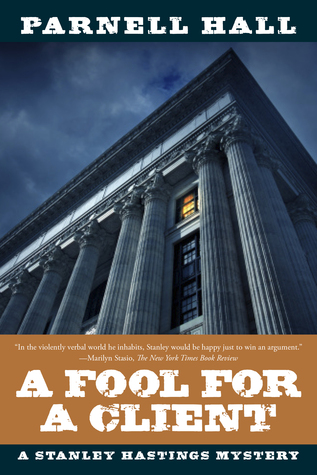
Parnell Hall: A Fool for a Client (Stanley Hastings Mystery #20)

"Tell me about the girl with tits."
"How'd you know about the girl with tits?"
"There's always a girl with tits. She may not have anything to do with the case, but you manage to make her important."
Stanley Hasting's boss, Richard Rosenberg, is in big trouble. Richard's girlfriend, a law clerk, has been murdered and the negligence lawyer is the prime suspect. Richard is the fool because he's decided to represent himself. Why? Because he doesn't trust lawyers: they're sleazy pond scum, and he's proof of that. He wants Stanley's assistance, but it's going to be hard: he was the last person seen with the victim, DNA proves he had sex with her, and his fingerprints are on the murder weapon.

The victim, Jeannie Atkins, was assigned to a global banking trial, which seems unconnected to anything that would have led to murder. She clerked for the judge, and usually judges take a dim view to their assistants being killed. Stanley hopes to find a connection, though, and becomes a regular spectator at the banking trial, which is just as exciting as you think it would be: not at all.

Our hero perseveres through the boredom, though, talking to jurors, alternates, a clerk with romantic ideas of what detectives do, and the long-suffering judge for the trial. He also finds "the girl with tits," Juror Number Twelve. Stanley discovers that she was an alternate promoted after someone else was excused. He procures the address of the excused man and pays a visit - to a dead body.

I've often wanted to see Richard Rosenberg at work, and this book doesn't disappoint. Most of the cases he takes involve trip-and-fall or accidents on city property. Half the people at court are scared of him, and we learn why. He turns down the probable cause hearing and goes straight to trial. He accepts all candidates for the jury without questioning them. He insults the expert witness. He insinuates that no one is telling the truth about when he left the victim's apartment because the security guard slunk off early and his limo driver was padding the time for higher pay. He makes Denny Crane look like a paragon of discretion.

None of this is going to matter, though, because the evidence is against Richard. He was the last person seen with the victim, his bodily fluids were present at the scene, and his fingerprints are on the murder weapon. He has no clue who the murderer is. Stanley's occasional ally, Sergeant MacAuliff, is of the opinion that Richard will only escape jail if he can 'pull an O.J.' and create reasonable doubt.

Will Rosenberg dream up a great strategy, or will he go to prison? Will Stanley find the real killer after all, or go to jail after giving grief to the judge in the banking case one too many times? Read A Fool for a Client to learn the answer to these and other relevant questions, including how often a detective's wife has to explain to her husband what the information he's discovered implies for the case.

I greatly enjoyed the book, but you may need to keep a scorecard for some of the conversations. The repartee zips back and forth very rapidly with few conversation tags. It's still very funny. I was also pleased to see Alice (Stanley's wife) again, who creates order out of her husband's eccentric observations.

Disclosure: I was given an ARC of this book to read and review. You can also see this review at Goodreads.com .

Monday, May 27, 2013

Review: I Am Murdered by Bruce Chadwick

I Am Murdered is Bruce Chadwick's account of the poisoning of George Wythe, close friend of Thomas Jefferson and a signer of the Declaration of Independence. His great-nephew George Sweeney was the prime suspect, and the subsequent trial is now referred to, at least by the publishers, as America's first 'Trial of the Century'.

Chadwick begins with a recounting of Wythe's poisoning, showing us the normal pattern of Wythe's morning and when and how things went drastically wrong. We learn of the shockwave his death sent through the Richmond of the early nineteenth century, and his close-knit group of friends, also known as 'America's Founding Fathers'. 


We learn who George Wythe is and why he is an important part of America's history, Virginia's in particular. He was America's first law professor, a member of the Continental Congress, the judge for the high Chancery Court of Virginia, and a co-reviser of Virginia's laws. This last will become pertinent later. Wythe was titled 'the American Aristides' and seemed to be universally loved - with one clear exception.


George Sweeney, a teenager, has been living the high life in a Richmond far less stodgy than the one that exists today. Sweeney is up to his eyeballs in gambling debts. As a result, the youth is always broke and begging money from the great-uncle he was named for. When Uncle George refuses, Sweeney forges checks in his name. There's a more permanent solution, of course, and young George doesn't have to be an Agatha Christie reader to come up with it: Uncle George is childless. Half of Uncle George's estate goes to Sweeney when he dies, and the other half goes to a mulatto protege that Uncle George has been teaching.


On May 25th, 1806, Sweeney visits the kitchen in Wythe's elegant home. The cook is convinced that Sweeney dumped something from a paper packet into the coffee. I would have dumped the contents personally; instead, everyone in the house, including the cook, drink the adulterated beverage and fall ill. The mulatto protege dies, opening up that half of the estate for Sweeney, but there's a problem: Wythe has a damned good idea that he's been poisoned, and who did it. He declares "I am murdered" (hence the title of the book), and insists that he be autopsied when he dies. He also lives long enough to change his will, disinheriting George entirely. Impressive for an eighty-year-old man, but this will also be pertinent later. 


Chadwick makes a strong case for Sweeney's guilt. Unfortunately, justice could not be served for a number of reasons, which Chadwick explains in detail in the rest of the book. It is rich in irony.


First: Wythe lived too long after ingesting the poison. The three prominent physicians, including Wythe's personal physician, were not absolutely certain that poison was the cause. They also refused to believe that someone could live two weeks after ingesting a fatal dose of arsenic, despite anecdotal evidence to the contrary. Cholera could have been the cause, or Wythe could have died from an excess of bile in his system. This wavering on the cause of death bolstered the defense. Chadwick makes sure that we know what a piss-poor job these men did with determining Wythe's cause of death, but to citizens of the nineteenth century, they were experts who knew what they were doing.


Second: as a lawgiver, Wythe was too much Solon with serious punishments and too much Draco where blacks and slaves were concerned. The revised laws forbade blacks from giving evidence against whites. This meant that his cook, the only living witness, could not testify against Sweeney. Another person, a man who found some concealed arsenic Sweeney had tried to ditch following his arrest, was barred from testimony for the same reason. This was especially ironic because Wythe was a staunch abolitionist who had accepted the harsher laws regarding slaves to get the whole body of law accepted.


Third: the economy of the nineteenth century had gotten ahead of the law where banking was concerned. Forging checks today is a criminal offense today. When the revised law of Virginia was completed in 1779, however, it did not include forgery against a public institution like a bank. The first bank in Virginia wasn't chartered until 1792. The prosecution couldn't even charge him with stealing from his uncle.


As a result, Sweeney was freed and swiftly left town.


There is a large amount of history and detail in this book, perhaps more than some readers will want to take on. It is a nonfiction work regarding a real crime, but it is in no way a lurid 'true crime' book. If you like in-depth history, though, or are an author, it's good reading. For the historical mystery writer, the book is a gold mine, covering several aspects of both Virginian and medical history. The notes and bibliography section provide plenty of avenues to locate more specific knowledge of events, education, and law. If you're setting a novel, especially a mystery, in the period following the Revolutionary War, this book could be a great help. 

Monday, May 14, 2012

Review: The Architect


The Architect
The Architect by Keith Ablow

My rating: 5 of 5 stars


West Crosse is an architect par excellence, a man of enormous creative vision and sensitivity to the needs of his wealthy clients. This is especially true of the homes he designs for families - anticipating both current and future needs. They are creations of light and space, temples to truth and beauty. Crosse is a man of high ideals.

But I wouldn't want him to design a house for me.

Crosse goes beyond planning perfect homes for his clients, you see. He also plans perfect lives for them. If a member of the family is an obstacle to the happiness and growth of the family, Crosse removes that person... and he finds one in each family he works for. An abusive husband, a wife who doesn't want children, a daughter with a drug problem - all of them must die for the good of the family.

Forensic psychiatrist Frank Clevenger is put on the case after the President of the United States begins receiving fan mail from the unsub who has been killing and surgically dissecting wealthy people across the country. Clevenger is beset by personal problems: his love life has taken a downturn, and his continuing problems with his adopted son Billy often steal the stage from the visionary killer on a mission from God. Fighting his alcoholism becomes harder and harder, and finally he begins prescribing Antabuse for himself to prevent falling into the pit for good.
In contrast, the families he meets during his investigation seem to be coming out of their own dark times. They seem calm, even happy... and even relieved at the death of their loved one, though they don't say so out loud. It makes investigating... interesting and nonrewarding at the same time.

I've read several books of Ablow's, and this one was an enormous pleasure to read. Crosse's sense of beauty and clean proportions take him out of the bounds of the 'average' serial killer, while Clevenger's personal life becomes a messy disaster. There are no simple solutions in our hero's world, and he's not going to get them in this novel. For Crosse, though, the mission is clear, and there is no hesitation in his actions. The consequences are horrible. If a movie were made of this book, Hollywood would have to alter the ending. The audience would not accept it.

A side note: the Skull and Bones group of Yale gets a lot of attention in this novel. Crosse belongs to it, and uses its connection to get contracts with the high and mighty. President Buckley (an excellent choice of names) is a member and, given the book's 2005 publication date, was probably meant to draw comparisons to George W. Bush. Ablow casts no aspersions on the Bonesmen, political or otherwise. Membership simply makes them more vulnerable to trusting The Architect and less likely to talk to investigators about other potential victims.


View all my reviews

Monday, February 13, 2012

Review: Movie by Parnell Hall

Movie
Movie by Parnell Hall

My rating: 3 of 5 stars


Detective Stanley Hastings finally has his chance to hit The Big Time as a screenwriter. Sidney Garfellow, a documentary director people have actually heard of, has hired him to write the screenplay for his first 'regular' movie. Stanley dreams of leaving his less-than-rewarding career as an investigator for a personal injury lawyer for the Silver Screen. What stands in the way of this? Well, Sidney Garfellow, who keeps changing his mind about what he wants, forcing Stanley to rewrite and rewrite again. Then there's the film's star, who ignores Stanley's golden prose in favor of more 'natural' lines he's written himself. Oh, and there's people getting killed on the set. Just a little problem there...

Hall draws heavily on his own experiences when writing Stanley Hastings: he has worked on the stage, in films, and, at one time, as a detective himself. He writes hilarious songs, often about the foibles of being an author. It is no surprise that he has some experience with screenwriting himself: he wrote the screenplay for C.H.U.D. At least Stanley gets to write a movie with "four hot babes" in it.

I've read several of the Hastings novels, and I always enjoy the verbal humor in them. This novel is no exception. Stanley gives us his unvarnished and aggrieved opinions of the director, the actor, and Murty the sound man. He exchanges marvelous barbs with his boss, who visits the set, and Sergeant McAuliff, a series regular who is hired as a consultant. After the deaths begin, Detective Clark is brought in to investigate. Stanley doesn't like Clark: in a previous novel, Stanley was his prime suspect. The cops are smart, especially Clark, who is far from the closed-minded nabob mystery authors so often employ. The plot is good, and there's enough twists to keep the reader guessing.

The drawback: in some scenes, Stanley and the police detectives spend a lot of time talking about who was where at what times. I tend to speedbump over those sections, but you might want to take the time to read it: the solution just might be hiding in there.


View all my reviews

Tuesday, December 27, 2011

Review: Defending Jacob

Defending Jacob
Defending Jacob by William Landay

My rating: 4 of 5 stars


In this legal thriller, assistant district attorney Andy Barber's comfortable and respectable life comes to a screeching halt when his fourteen-year-old son, Jacob, is charged with murdering one of his classmates. Andy is suspended from his position so he cannot unduly influence or garner information from the people he has worked with for years, cutting him off from the natural resources he needs to defend his son from the charges. Instead, he finds himself on the other side of the courtroom watching his greatest professional rival do what he can to put Jacob away for good. As part of the defense, Andy is forced to confront the dirty secrets of his own past, which he has never revealed to his co-workers, his son, or even his wife.

I normally don't read novels this length (421-page Advance Reader's Edition) unless I already know the author or the story itself grabs and holds my interest. Defending Jacob falls into the latter category. The description I gave above could easily be the trailer of a Lifetime drama, but this novel rises above a maudlin TV drama for several reasons. The disintegration of family trust is not a surprise, nor is it a shock to the reader when friends, neighbors, and co-workers turn against the family. What the reader doesn't get, though, is a reassurance that Jacob is innocent. Too many secrets aspects of the teen's life are revealed during the investigation: we learn that Jacob has a dark side. Bad decisions made by both the boy and his father (who knows better, but cannot help himself) also make proving innocence -or guilt- very difficult.

We also learn that Andy comes from a long line of violent criminals in which he appears to be the (only?) exception. He has spent his entire adult life keeping his heritage a huge blank spot, even to himself. Naturally, his family background comes out during the investigation. When the trial outcome appears darkest, the defense attorney tests Jacob for a specific genetic predisposition to violence that could mitigate his sentence. Andy is forced to visit his own father, Bloody Bill Barber, in prison to beg a DNA sample for corroboration. The relationship they begin to develop isn't pleasant, but it is interesting.

The ending has more than one twist. There is a certain point at which the reader may feel cheated, but stay tuned: the other shoe just hasn't dropped yet. Throughout the book, we read testimony that Andy is giving at a trial. It isn't until the end that we discover whose trial it is.

Spoiler alert:
A great amount of emotional focus revolves around the question of whether the Barber men are born killers or not. My problem with the genetic condition Landay employs (a real one) is that the trait is sex-linked to the X chromosome - the one chromosome men do not pass down to their sons. The novel specifically states that the allele is located on the X chromosome, which immediately jarred me out of the plotline and onto Google. Most people who read this sort of novel have taken enough biology to say "Couldn't Jacob only get that gene from his mother? Why aren't they testing her family, too?" Since my copy of the novel is an ARC, I am hoping some editor has already spotted and solved this problem.


Overall, Defending Jacob is an engrossing read. It is well-written, outside of the genetics issue. Andy's willful belief in his son's innocence and the desperate acts he commits to shield his son drive this story, and kept me turning pages till I reached its open-ended conclusion.


View all my reviews

Saturday, December 03, 2011

Decompression

The 2011 book tour is over, and NaNoWriMo is over as well. Finally, I get to come out of crazy writer mode - just in time to make the shift into crazy holiday mode. If I find the time between now and January, I might be able to do some book reviews. The great thing about attending Bouchercon is the number of free books and review copies the attendees receive. I have several interesting ARCs in the island of paper products surrounding my end of the couch.

Oh, yeah, I might want to sort that pile out. Right now, our living room looks like a ransacked library. Let's not discuss what the kitchen looks like.

But the first fun thing I'm getting to read is from my wife, Gwen Mayo. She's almost finished with the sequel to Circle of Dishonor. Guess who has the first 55K words of that sequel on a memory stick jacked into her laptop? You got it. I'm the person who sees her stuff before the beta readers. I guess that makes me the alpha reader.

Anyhoo: Sorry for the breaks between posts. I have been waaaayyy too active this year.

Saturday, July 30, 2011

Review: The Hunt by Linell Jeppsen

This novel is described on Amazon as a story where two vampire factions clash in the Washington State woods during the height of deer season. When I read this, I thought: "Lunchtime!" Ancient creatures meet tourists? It worked for Jurassic Park...

If you are hoping for a major bloodbath, however, you will be disappointed. Two ancient foes do meet in a final conflict that has consequences for the humans who are unfortunate enough to be in the way. Outside of a few well-described deaths, though, the main focus is on the life and relationships of Raphael Goldhawk, half-breed and eventual king of the high vampire council.

In the world Jeppsen creates, vampires are a different, older species than humans. They resemble angels in many ways: they're winged, they have an alien beauty, and most of them have Biblical names (Gabriel, David, Lael). The race has become infertile over the centuries, so their hope of continuation rests with Raphael and his offspring. Raul (non-Biblical name) is the villain of the piece. To Raul and his followers, humans are food and Raphael has no business hanging around with real vampires. This leads to a series of conflicts that resulted in the death of Raphael's wife and a duel between the two vampires two hundred years ago. Raphael spares Raul's life, to his regret.

Jeppsen writes reasonably well, but the novel has serious structural problems. The story begins with the viewpoint of the humans, set in the here and now, but the overwhelming majority of the book is background, telling us the saga of Raphael Goldhawk. I found myself wondering when we were going to return to the present time and rejoin the main storyline. To me, it seems that the story of Raphael was the main storyline and should have been presented as such.

That said, I think that Linell Jeppsen is, overall, a promising writer. She went to the trouble of researching the things she could research for her story and sought out input from others (whom she acknowledges in her introduction). Her human characters are markedly different from her vampires in the way they think, speak, and their background descriptions. The joining of Raphael and Melissa, for example, is much more mythic and dramatic than the 'real folks' relationship of Holly and Brian. The characters of Raphael and his family are compelling enough to follow, despite my comments on the overall novel structure.

About the Author
Linell Jeppsen is a retired grocery store checker and high school custodian. She has been writing her entire life, but was recently chosen by Phyllis Scott Publishing for her novel, The Hunt.
She had previously won third place in a science fiction short story contest for "The Gag Gift", which is featured in Mixed Blessing and other Short Stories and The Last Astronaut.
Linell is now hard at work on her second novel, titled Story Time. It is a science-fiction, post-apocalyptic novel, which is due to be released this fall.
For more information about Linell and her work, please visit:
•    www.linelljeppsen.com

--

Tuesday, April 12, 2011

Review: Other Eyes

Other EyesOther Eyes by Barbara D'Amato

My rating: 3 of 5 stars

This thriller begins with an arresting scene: a baby crawls across several lanes of traffic on I-90 in Chicago. The baby is saved, but police detective Tommy Pollard no idea of who he is or where his parents are.

Unfortunately, we're not going to return to the baby for a while. Instead, we are introduced to Blue Eriksen, an archaeologist with controversial ideas. We eventually figure out - fifty pages into the book - that she is the baby's mother.

Then, there's the dread assassin the FBI agents are pursuing. Felix Hacker is in Chicago for some reason, and it can't be good. FBI agent Marcus plans to catch him with the help of other agents, but Hacker slips out of town after several stupid mistakes on the parts of the locals.

We bounce between Blue blithely planning research in Peru and the Keystone Kop action... what about the baby? Eventually, we get back to Detective Pollard, who is more astute than the group chasing the assassin. He traces the baby's trail back to Blue's house, where he finds that the father, Blue's ex-husband, has been murdered.

Eighty pages into the book, Blue discovers that her baby is the one everybody has been talking about. This pretty much sets the pace of the novel.

Blue clears things up with the police - she was being interviewed about her controversial theories at the time of the murder, so she has an ironclad alibi. Then, we travel to Peru with her.

The trip is highly educational for the reader. We learn a bit about modern Peru, but we learn more about the ancient Peruvians. Blue likes to visualize how the skeletons they discover wound up in their current condition, so we are treated to several vignettes of the lives of these ancients.

Oh, and there's a cartel that's trying to get the drug dealers in Mexico on the same page. By the way, they hired Hacker to kill Blue because she thinks hallucinogens might be able to cure drug addiction.

Hacker's still trying to kill Blue. After a failed attempt to kill her with a rockslide, it becomes a matter of principle for him to complete the job.

One of Blue's fellow professors is killed in the slide. His brother works in Europe, solving art crimes. The latest theft was inspired by a story written by Jacques Futrelle. Fortunately, the brother is also familiar with the story.

Blue goes on to Turkey. More research, more vignettes. She finds out that the rockslide was no accident, so she calls in the brother for assistance. More intrigue follows... but first, the baby's birthday party.

Barbara D'Amato has a great track record as an author, but I had serious problems finishing this novel. There were so many intervening scenes and situations, the thread - and, more importantly, the excitement - of the main plot was lost again and again. And I'm speaking as someone who likes history, archaeology, and mystery religions.

I enjoyed D'Amato's writing style and the information on the ancient cultures... but there was too much education and not enough time spent on the central plot. Fans of archaeology may enjoy this book, but if you're expecting a James Bond-style caper with a secretive crime cartel and a relentless assassin, prepare to be frustrated.

View all my reviews

---

Saturday, March 19, 2011

Review: A Heartbeat Away

A Heartbeat AwayA Heartbeat Away by Michael Palmer

My rating: 3 of 5 stars


As Michael Palmer’s books rise in popularity, he raises the stakes higher and higher. His earlier books focused on doctors running afoul of conspiracies in their local hospital; now, his writing eye is fixed on terrorism and government conspiracies - with a medical twist, of course.

In A Heartbeat Away, the first physician we meet is the President of the United States. James Allaire is preparing to give the first State of the Union address of his second term. Among the issues he plans to focus on - in front of his assembled allies and enemies - is terrorism, most notably that of Genesis, which appears to be a home-grown left-wing cadre. As he makes his opening remarks, small explosions occur throughout the crowd. Genesis has planted a Level Four virus, WRX3883, around the congressional chamber, and everyone there has just been exposed to it.

The back cover of Heartbeat lists the presidential order of succession. This becomes relevant quite quickly. Everyone listed in that order was at the address except, ironically, the Secretary of Homeland Security. Palmer lets the reader know that at least one person in the line of succession must be away during such events because of revolting developments like this.

Allaire knows the virus is highly lethal; he discontinued the government's development of it after it was stolen. It acts like SARS with a side helping of Ebola is also contagious. He must control the panic in the Chamber - and seal the building. No one gets in, no one gets out. The scientist who headed the WRX3883 project is missing. Her subordinate, Griffin Rhodes, is in prison for stealing the virus.

Rhodes is the only chance they have. Allaire promises him a presidential pardon if he comes up with a cure. The secret lab has been reopened and his old lab assistant will be waiting for him. Rhodes demands a witness. He was framed for the theft and railroaded into prison. He doesn’t trust the president. Angela Fletcher, a reporter for the Washington Post, will follow Rhodes and make sure that no one changes ‘fact into fiction’. That, and every drama needs a love interest.

The newly freed Rhodes goes to work on finding a cure. Angela tries to locate the missing WRX3883 project head. Genesis, which has eyes and ears everywhere, targets the would-be saviors. Meanwhile, they’ve contacted the Speaker of the House and offered her the cure – and the Presidency – if she cooperates with their demands. It makes for a barrel of fun.

I like stories with a medical angle, and Palmer gives us a taste of the science involved, doing a good job of explaining the research and aspects of human biology without going into pages of jargon. Are there some five-dollar words in there? Yes, but you can speed-bump over the worst parts or fire up Google. Don’t worry, he gets back to the story quickly.

I also enjoyed the political backstabbing that began almost immediately. Palmer does not identify his office holders by party affiliation and does his best to avoid making them resemble their real-life counterparts. I couldn’t suppress a snicker, though, when the senior senator from my state ran afoul of the Secret Service. It was only fiction, after all…

I initially had problems ‘buying’ a group like Genesis: left-wing terrorists of this magnitude? I’m sure there are violent loons on the left; it’s their level of organization that bothers me. Genesis is not what it seems, though. I’ll leave it at that.

What I would have liked: a little more medicine. There are seven hundred infected patients, but we don’t see much of how WRX3883 affects them or what’s being done to help them. A scene where Doctor Allaire was treating a sick congressman would have been nice. He should have been berating himself the entire time, too. Presidents sometimes have to do vile things for the best interests of all, but he should have regrets.

Another problem: Allaire’s political enemies are too one-sided. They hate him – no surprise – but most villains see themselves as the heroes. They also have personal principles and agendas. Perhaps Palmer didn’t want to get into those because then we could ‘peg’ them politically, but at the very least they should have families and people they worry about. The Speaker’s actions at the end were too over-the-top for me. Perhaps, if Palmer had shown her being more affected by the illness, it would have helped.

Spoiler alert for my biggest complaint: the virus WRX3883 was being developed in the first place because it had a side effect that worked better than truth serum and also dissolved self-control. It would have made it damned hard for the Speaker to conceal what she’d done with the Vice President. The arguments that would have ensued when everyone began telling the truth could have also been damned interesting.

Overall, though, I found A Heartbeat Away to be a good read. It’s not my favorite of his works, but it has plenty of action and keeps you turning the page.

View all my reviews

ShareThis