Wednesday, August 21, 2019

Interview: Michael Williams, Author of Trajan's Arch

Over the past 25 years, Michael Williams has written a number of strange novels, from the early Weasel’s Luck and Galen Beknighted in the best-selling Dragonlance series to the more recent lyrical and experimental Arcady, singled out for praise by Locus and Asimov’s magazines. In Trajan’s Arch, his eleventh novel, stories fold into stories and a boy grows up with ghostly mentors, and the recently published Vine mingles Greek tragedy and urban legend, as a local dramatic production in a small city goes humorously, then horrifically, awry.
Trajan’s Arch and Vine are two of the books in Williams’s highly anticipated City Quartet, to be joined in 2018 by Dominic’s Ghosts and Tattered Men.
Williams was born in Louisville, Kentucky, and spent much of his childhood in the south central part of the state, the red-dirt gothic home of Appalachian foothills and stories of Confederate guerrillas. Through good luck and a roundabout journey he made his way through through New England, New York, Wisconsin, Britain and Ireland, and ended up less than thirty miles from where he began. He has a Ph.D. in Humanities, and teaches at the University of Louisville, where he focuses on the he Modern Fantastic in fiction and film. He is married, and has two grown sons.

What made you decide to start writing your own stories?
I think most every kid is in love with hearing and telling stories.  It's hard-wired in how we understand things and how we learn.  The big transition for a few people, though, comes at the moment when they say to themselves that they'd like to make storytelling a lifelong pursuit.
For me, that happened at 13 or 14 when I read Tolkien's Lord of the Rings for the first time. In chapter 3 of The Fellowship, there is a moment when the hobbits get off the road at the approach of someone—someone who turns out to be one of the Dark Riders of Mordor, who attempts to sniff out (literally) our heroes in the undergrowth.  I remember lifting my eyes from the page and realizing I had been immersed in Tolkien's world—completely there—for almost half an hour.  From that experience and a number that followed, I decided that creating that effect was something I wanted to do forever.

Which authors influenced your writing?
Obviously Tolkien, when it came to world-building and the use of myth and legend to inform and underlie the way my stories worked.  Several of the great magical realist writers—Garcia Marquez and Borges come to mine—for the way they wed the everyday with the wondrous.  My old mentor John Gardner (author of Grendel and The Sunlight Dialogues) taught me invaluable things, and there are half a dozen or so poets (among them Yeats, Dylan Thomas, and Ted Hughes) who were very formative for me around the time I really became serious about writing.

I'm a bit of a tyro in the humanities. What is the Modern Fantastic?
I'm thinking this question stems from your reading that I teach courses in the Modern Fantastic at the University of Louisville.
It's pretty much what it sounds like: fantastic fiction, film, and art from the middle of the 19th century to the present day.  The late 19th century, for me, is that time in history when we began to look at fantastic worlds as mental or psychological landscape, when these stories help establish the theory and vocabulary of thinkers like Freud and Jung.  Just think “fantasy from the 1880s to the present.”

Tell us about the City Quartet. Which cities are involved, and can you tell us a little about each story?
One city—Louisville, Kentucky, in both an historical and an imagined version.  These are four novels (you can enter the world of the books through any one of them—there's no designated reading order, no idea of linear “sequence” or “series”).  The stories of the books interweave, so that a principal scene in one novel might be glimpsed in passing in another, a principal character in one might make a cameo appearance in another.  In short, the books speak to the connections that bind us all in location and in history, and one of their major areas of meaning is in how our lives intertwine, how we depend and rely on each other.

  • Trajan's Arch: Gabriel Rackett stands at the threshold of middle age. He lives north of Chicago and teaches at a small community college. He has written one novel and has no prospects of writing another, his powers stagnated by drink and loss. Into his possession comes a manuscript, written by a childhood friend and neighbor, which ignites his memory and takes him back to his mysterious mentor and the ghosts that haunted his own coming of age. Now, at the ebb of his resources, Gabriel returns to his old haunts through a series of fantastic stories spilling dangerously off the page–tales that will preoccupy and pursue him back to their dark and secret sources. 
  • Vine: An Urban Legend: Amateur theatre director Stephen Thorne plots a sensational production of a Greek tragedy in order to ruffle feathers in the small city where he lives. Accompanied by an eccentric and fly-by-night cast and crew, he prepares for opening night, unaware that as he unleashes the play, he has drawn the attention of ancient and powerful forces.
  • Dominic's Ghosts: A mythic novel set in the contemporary Midwest. Returning to the home town of his missing father on a search for his own origins, Dominic Rackett is swept up in a murky conspiracy involving a suspicious scholar, a Himalayan legend, and subliminal clues from a silent film festival. As those around him fall prey to rising fear and shrill fanaticism, he follows the branching trails of cinema monsters and figures from a very real past, as phantoms invade the streets of his once-familiar city and one of them, glimpsed in distorted shadows of alleys and urban parks, begins to look uncannily familiar.
  • Tattered Men (to be released in September: When a body washes ashore downstream from the city, the discovery saddens the small neighborhood south of Broadway.  A homeless man, T. Tommy Briscoe,  whose life had intertwined with a bookstore, a bar, and the city’s outdoor theater had touched many lives at an angle.  One was that of Mickey Walsh, a fly-by-night academic and historian, who becomes fascinated with the circumstances surrounding the drowning. From the beginning there seems to be foul play regarding Briscoe’s death, and, goaded on by his own curiosity and the urging of two old friends, Walsh begins to examine the case when the police give it up.  His journey will take him into the long biography of a man who might have turned out otherwise and glorious, but instead fell into and through the underside of history, finding harsh magic and an even harsher world.  Despite the story of Tommy’s sad and shortened life, Walsh begins to discover curious patterns, ancient and mythic, in its events—patterns that lead him to secrets surrounding the life and death of Tommy Briscoe, and reveal his own mysteries in the searching. 

How did you get from a triumphal arch in Italy to modern-day Louisville?
Sheer imagination, metaphorically and literally. The triumphal arch is present  only in an article Gabriel reads during his initial fascination and curiosity with Trajan. The real “arch” is the series of stories Trajan Bell has written, inserted in the novel and over-arched, you might say, by the novel itself.  There's another arch late in the book, but to say much more would be letting spoilers slip.

Is there a new author or book out there that you think we should be reading, and why?
I'm interested right now in more “world fiction”--magical realist stories from outside the Anglo-American world (and, for that matter, non-European writing).  Two women writers, strikingly different from each other, I've been reading with some pleasure.
Karen Lord is a writer from Barbados, with roots in Senegal.  Her Redemption in Indigo is a darkly funny mythic journey, a retelling of the folktales centering on the West African legendary figures of Anansi the Spider and Ansige Karamba the Glutton.
Lesley Nneka Arimah is a Nigerian writer who mingles magical realism and speculative fiction with the very realistic treatments of the harsh political realities in her native country. Her What It Means When a Man Falls From the Sky is a stunning collection of short fiction.
Recommending the work of both these writers is my gift to you, my thanks for giving me space to talk about my own work.

Many thanks! Trajan's Arch is now available from Amazon and Barnes and Noble.



Friday, August 02, 2019

August

Ah, August. A time when my email boxes overflow... Strangely Funny submissions are pouring into the MAHLLC coffers, and my personal email has become a FEMA flood zone of politicians pleading for money. Volunteering is the gift that keeps on giving...
An update on the past few months:

  • I began temping in a call center in April, mere days after posting how discouraged I felt. In July, the center hired me away from Randstad. I'm happy to be wanted, but I can't figure out why. My father was a great salesman of school textbooks, and all I picked up was a love of reading. This belligerent introvert is learning new skills.
  • My ebullient sister-in-law is moving to Tampa Bay in the next few weeks. It will be good to have more family here, and I may develop a social life despite myself.
  • Gwen and I have finished Murder at the Million Dollar Pier, the sequel to Murder on the Mullet Express. It's the second book in the Three Snowbirds series, and we'll be doing a cover reveal in the near future.

I'm glad that my life is coming back together. We'll see what these changes bring.

Sunday, May 05, 2019

The Other Surprise Derby Winner

My S-I-L made a lovely hat for the Derby Party!
Yesterday's Derby was a major surprise. For the first time in Derby history, a winner was disqualified due to infractions during the race. Country House became the official winner after Maximum Security had already done a victory lap.

We no longer live in Kentucky, but we did go to the Derby Party thrown in our mobile home park. My sister-in-law is visiting, and she threw together a lovely hat at short notice.

While the television announcers talked about past Derbies, gave the changing odds on favorites in the current race, and interviewed trainers and jockeys, our group staged races with stick horses. There was betting going on with these races, too, but no one was going to win or lose big at a quarter per ticket.

We placed a wager at my table on the Big Race. Since I didn't know anything about the horses running this year, I chose Tacitus. I spent several years as a classics student, so it was a natural for me. Furthermore, it sounded like a real Derby winner name. The first time I was asked to identify Aristides on a test, I replied that he was the winner of the original Kentucky Derby. Oh, and that he was an Athenian statesman.

None of our horses won. However, Tacitus took third place after the judges declared the official winner of the race. Since I was the only one with a horse on the board, I won the pot. It was a pleasant evening with a suprisingly rewarding ending.


Tuesday, April 23, 2019

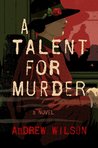
Review: A Talent for Murder by Andrew Wilson

A Talent for MurderA Talent for Murder by Andrew Wilson
My rating: 5 of 5 stars

This is the first novel in a series starring the author Agatha Christie as the main character. Biographer Andrew Wilson spins several well-researched events of 1926 into a gripping tale of why Agatha Christie disappeared for several days, and what happened during that time. He's not the first person to do so - the movie Agatha springs to mind - but Wilson's version grabbed me from early in the book and wouldn't let go.
The book opens with Agatha's despair. Her husband, Archie (played in the film by the swoonworthy Timothy Dalton) has fallen in love with a younger woman and doesn't understand why his wife isn't being reasonable about giving him a divorce. Wilson must have suffered a broken heart at least once; he describes Agatha's pain in convincing detail. Her misery is interrupted when she is pushed into the path of a train, and then 'saved' by a man who is no hero. Dr. Patrick Kurs has been following her exploits for some time, and he believes she should perform a service for him. In exchange for not releasing love letters between her husband and his mistress, he wants Agatha to kill his wife. He will arrange to be elsewhere, and she can put her knowledge of murder to good use. When she balks at his demands, he threatens to harm her family, specifically her daughter. Convince of his ability to hurt them, she agrees.
Kurs only allows her to decide how to commit the murder; the rest of her actions follow a plan he has already devised. First, Agatha disappears into the countryside, abandoning her car and her fur coat for the police to find. She is allowed to keep her purse, which contains a pouch of poisons. He forces her to check into the Swan Hydropathic Hotel under the last name Neele (the name of Archie's mistress) and, later that evening, to dance the Charleston at his command. These have little to do with the crime he wants her to commit; they are designed to humiliate her and reveal how much she is under his control.
We are occasionally given a glimpse into the police investigation of Agatha's disappearance and a separate investigation by a young woman who is also determined to find her, but never for long. The focus always returns to the mental battle between the fiendish Kurs and Agatha Christie, one of the world's cleverest plotters. He humbles her again and again, but she finds an interesting way to give him what he wants.
This book is very well written and researched. Wilson shows us true details of Agatha Christie's life, and uses what is known about her disappearance as the framework for a powerful conflict between two very clever and determined people. I recommend it.

View all my reviews

Saturday, April 20, 2019

Unemployment and Depression

I'm afraid that the job I accepted in February fell through. I received about three weeks of pay for it, so I did receive some benefit. Around the same time, I came to the end of my severance pay. Since I'd been keeping track of my job applications, the next step was applying for unemployment.

You may have been told that the unemployed are lazy people sitting around collecting money for nothing. I need to tell you two things: 1) I'd rather be working than going to interviews and having my hopes dashed again and again, and 2) I get $275 a week, which might be a lot in some states, but not in the Tampa Bay area. An article in the February 7th edition of the Tampa Bay Times states that the 'survival income' for a family of four is $60K/year. That's $5000 a month, in case you don't want to do the math. The 'survival income' for a single person is a little under $21K.

Gwen and I are a family of two. I am bleeping grateful that she still has a job, because I am alloted a little over $3000 for this year. That's how unemployment works. To qualify for it, I'm supposed to list five places I applied for work during each week. I usually list ten or more. I want out of this arrangement. Next week, I'm doing a workshop on successful interview techniques because I haven't done many, and I'm enough of an introvert to need help with social interactions that involve charm as well as answering questions.

Being rejected again and again is painful. It's especially so when I've taken skill assessments for temp agencies and been told how good my scores are. Sometimes I've been rejected because I lacked 'front office' experience. Other times, I've been advised to leave some of my experience off my resume because of either a) age discrimination or b) I would look too skilled for the jobs I was applying for. Folks, my ambitions are in writing, not in becoming a corporate raider.

This past week, I learned of a new complication: at least one of my previous employers doesn't give references. Instead, they use a service to confirm employment. This service costs money for prospective new employers to use, and I've learned it's not a new practice. I will contact the service to get what free verifications I am entitled to, but now I'm wondering how many jobs I lost because the employer could hire someone whose records they could verify without a charge. Stupid me.

This whole experience has eroded my ideas of who I am and that I have something to offer to the world. I've always been a steady worker; I spent over seven years in my first 'real job' and about fifteen in my second full-time position. I was approaching five years with my last employer when I was laid off. They treated me well in the process and gave me good severance, but I haven't found a place in this Brave New World of Work.

I'm not ready to quit looking for work. But I understand why some people have.

Wednesday, February 27, 2019

Review: Smoke and Ashes, by Abir Mukherjee

Smoke and Ashes (Sam Wyndham, #3)Smoke and Ashes by Abir Mukherjee
My rating: 4 of 5 stars

"The first drag of the first pipe was a deliverance, like the breaking of a fever. With the second pipe, the shaking stopped, and with the third, the nerves steadied."

Sam Wyndham's error was calling for a fourth. Smoke and Ashes spotlights Wyndham's opium addiction in the first scene--and nearly ends his career with the CID at Lal Bazar, when the vice division raids the Calcutta den he's visiting. During his escape from the authorities, Sam discovers a dying man, curiously mutilated. He continues his flight, but begins a low-key investigation into the murder, which mysteriously appears to remain undiscovered as far as the authorities are concerned.

A more pressing matter is on his superiors' minds - the Indian National Congress and its leader, Mahatma Gandhi. The cause of self-rule have swept the country, with protest rallies, labor strikes, and the burning of British textiles. The Prince of Wales is touring India to restore goodwill and the status quo, and he is coming to Calcutta for Christmas. Alas, there will be no carols about it. One of Gandhi's primary supporters, C.R. Das, is leading the non-cooperation movement in the city, and Lord Taggart is sending Sam and his sergeant, "Surrender-not" Banerjee, to persuade him not to stage protests or stunts during the visit.

Sam Wyndham isn't looking forward to the job:

"I hated this new breed of pacifistic Indian revolutionary. So often they acted like we were all just good friends who happened to disagree about something, and that once the issue was resolved - obviously in their favour - we'd go back to taking tea and being the best of chums. It made punching them in the face morally difficult."

Shortly after their first visit to see Das (fruitless, of course), the second body turns up - mutilated like the man from the opium den.

The Das intervention and murder investigation turn the wheels of the plot after that, taking us into an unsavory part of British history in India, until all the elements come together at the climax of the book, shifting what was a mystery into a thriller.

My greatest pleasure in reading Abir Mukherjee, comes from his use of the language, his ability to slide between cultures, and his philosophical view of his subject matter. His commentary through Sam reminds me a bit of John D. MacDonald's writing.

"Calcutta was a city divided in more ways than one. To the north, there was Black Town, home to the native population; to the south, White Town for the British; and in the middle, a grey, amorphous area full of Chinese, Armenians, Jews, Parsees, Anglo-Indians and anyone else who didn't fit in. There was no law demarking the city, no barriers or walls; the segregation was just one of those things that seemed to have evolved when no one was paying attention."

His observations and seamless writing make the entire series a worthwhile read.

View all my reviews

Friday, February 22, 2019

Review: That Old Scoundrel Death

That Old Scoundrel Death: A Dan Rhodes Mystery (Sheriff Dan Rhodes Mysteries)That Old Scoundrel Death: A Dan Rhodes Mystery by Bill Crider
My rating: 4 of 5 stars

Confession: I haven't read a lot of Bill Crider, unlike most of the literate world. So, I'm reviewing his final Dan Rhodes novel as an outsider looking in.

The book opens with Sheriff Rhodes making what he thinks will be a motorist assist, only to discover that he's stepped into a road rage incident. Kenny is not appreciative of 'Cal Stinson's' driving, and is threatening him with a gun. Rhodes, who appears to always be clear-minded under pressure, subdues Kenny and arrests him.
The next time Rhodes sees 'Cal', the young man has been found dead in an abandoned schoolhouse in Thurston. His true name is Lawrence Gates, and he's not local.

The old schoolhouse is the center of community debate at the moment; some people want it torn down, others want it restored. Rhodes must tangle with the families at the center of the conflict, along with all the other problems Blacklin County can muster. The mayor is angry because a local blog has called him a nincompoop, the local buttinsky Seepy Benton has decided to become a private eye, someone is trying to kill Kenny and Noble (for good reason), and Rhodes' cohorts, Hack and Lawton, constantly complain about being left out of "the loop".
His wife Ivy keeps feeding him kale, which he hates, and he must sneak in his donuts and hamburgers while handling his duties. Meanwhile, reporter Jennifer Loam has reminded him that an election is coming up, and Rhodes isn't sure he wants to run again.

Despite these speed bumps, Rhodes continues his investigation into Gates' death. The closer he gets to the truth, the more he realizes that the schoolhouse issue is just the window dressing for the real issue.

What I enjoyed most in this novel were the gentle humor in the author's voice and how very realistic the characters were. I worked at the reports desk for a police department back in the Stone Ages, and Crider's depiction of Kenny Lambert (a miscreant with a snake tattoo on his neck) and Noble Truelove (badly named) reminds me very much of some of the jokers our officers encountered. The witnesses he interviews are also typical Southerners: they take forever to get to the point, and you're going to learn some history along the way.
Rhodes gets into dangerous situations, but they aren't due to macho behavior or idiocy; they're just things he has to do as sheriff. He also resolves them without loud bravado or action hero moves, something else I respect.

"I want to think that my end will be handled the way I'd like it to be handled. It would be a comfort to me to know that."

The above was from a thought-provoking conversation between Clyde the undertaker and Sheriff Dan Rhodes. Bill Crider was open with his cancer diagnosis, and writing what was likely to be his last Rhodes novel.

I couldn't help but notice the enormous cast of characters in this book, and I discovered that many appeared in previous adventures. He also showed us the new people who took over Hod Barrett's grocery store in Thurston. I couldn't help but think that this was a gift to long-term fans - giving everyone a last glimpse at their favorites, and perhaps concluding a few arcs. He, too, was handling the end the way he wanted it to be handled.

In an afterword, Crider thanks many of the people who helped him along the way in his writing career. He also gives his own opinion on whether Rhodes should run for sheriff again, but I'll leave that for you to discover.

I received a free copy of this novel in exchange for an honest review.


View all my reviews

Wednesday, February 20, 2019

Guest Post: Daniel Dark

As a historical mystery writer, I was intrigued by the notion of a hosting Daniel Dark, a Victorian chef, on my blog. I've read a lot of fiction from the era, and it's fairly clear that their daily dishes were quite different from our own. I asked Mr. Dark if he could educate us, and he obliged:

Well, let us take a look at a few of those items, starting with one that I wrote a whole cookbook about.

1) Catsup: I am not offering the thick over sweetened flavored corn syrup that most know about now. In Victorian times, Catsup was made from many things before it became tomato starting with spiced and seasoned fermented fish brine. Later on, the word became associated to any spiced acidified sauce. There were many variations to this according to where the sauce was being made and the available base products. In England you had mushroom, walnut, and fish or oyster catsup in most shops, but you would have been pressed to find banana. In the northeastern coastal areas of America, there would be no lost for supply of lobster catsup or cranberry catsup. (For more info, see Victorian Catsup by Daniel Dark.)

2) Today if I offered you roasted pigeon or blackbird pie with little clawed feet sticking out of it you may think I would be crazy. Now, if I offered you the French delicacy of roasted Squab, you might be more interested. Now, that pie has graduated to a more common dish of a pot pie.
3) In Victorian times no part of an animal came to waste. With all of the government scares, you may be able to find hog jowl or cheek in some groceries, but what about the rest of those delectable parts found in the head such as eye balls or brains that mix so well with eggs?
4) Other parts of animals that were of high regard were feet, bone marrow, and testicles (also known as mountain oysters).
5) Desserts were more common to be savories than sweet. This was normal considering the high cost of sugar, which was at the time a commodity that was kept under lock and key in most houses that could afford it.
6) Now. on the other hand, in the Victorian times lobster was fed to the convicts in prison considered the cockroach of the sea and thought of as inhumane to feed it to them more than three times a week.
7) In Victorian times until the late part refrigeration was almost unheard of, so eating was done seasonal with canning or curing done during certain parts of the year according to when the crops came in.

This is effectively a short list of how things have changed in a short two hundred years. And it could be expanded many times over.

***

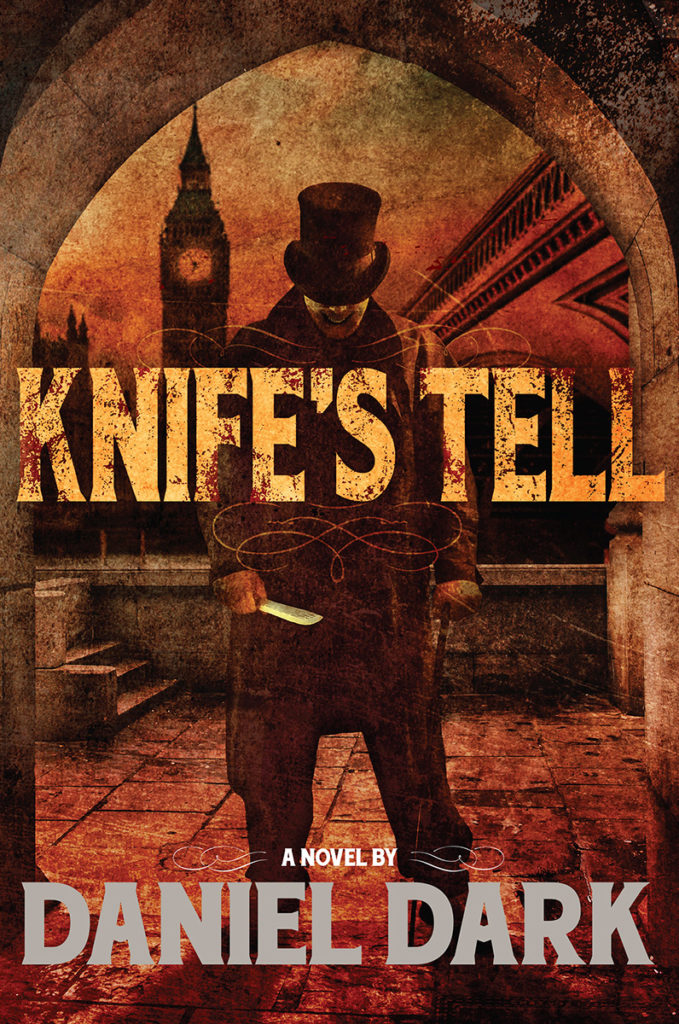
Daniel Dark Knife's Tell & Vctorian Catsup Blog Tour!

February 20-27, 2019

Explore the shadows of Victorian Era London and encounter a new Jack the Ripper tale like you’ve never read before in Daniel Dark’s Knife’s Tell & Victorian Catsup Blog Tour, taking place February 20-27!

Knife’s Tell contains a tantalizing blend of thriller, horror, erotic, and alt. history elements. As an added bonus, author Daniel Dark (a former Victorian chef) also has included the authentic Victorian Era recipes of the dishes that are featured in the story!

In addition to Knife’s Tell, this tour also highlights Victorian Catsup: Receipts of the Past, which features history and recipes for a wide variety of authentic, Victorian Era catsups. The book itself also has a great story behind its development, and it is attached to a wonderful cause!


About the author: Daniel Dark, a native of Nashville, Tennessee, grew up with homicide every day. Having a homicide detective as a father, he was able to learn about those that were brought to justice, and the ones that were not.

Spending many hours in Central police headquarters and in his grandfather’s hematology lab gave Daniel an unusual childhood and a love for science. Along with this, his great uncle owned the oldest book store in Nashville. His parents took him there regularly, where developed a love of reading and found out about history.

Daniel went on to become an Electrical Engineer and Industrial Maintenance Manager till NAFTA took away his job. A year later he went to culinary school and studied Victorian cooking, after which he opened a Victorian-style restaurant.

He became a heart attack and stroke survivor at fifty years old, where he used writing to rehabilitate his brain. The first book written by Daniel was on Victorian Catsup, which had over two hundred catsup recipes in it from the late 1700’s to 1910, with over sixty different flavors. Daniel used the book to start his 1876 Catsup company as Mr. Catsup.

Knife’s Tell represents his debut novel as an author.


Book Synopsis for Knife’s Tell:  
In 1888, one of the most notorious serial killers in history plagued London’s East Side.

Knife’s Tell is not about those murders, but the life behind them. What would cause a normal person to slay in such a horrific way?

Daniel Dark has explored an alternative tale of a doctor lost in reality trying to correct his past. With the help of his personal servant, he searches the Chapel for answers about his connection to the man with the knife.

Where did he come from? And how is the doctor part of his plans for escaping the police at every turn?
Read Knife’s Tell to learn the story behind the blade that killed London.


Book Synopsis for Victorian Catsup- Receipts from the Past: 
The book you now hold in your hands is nothing new, only forgotten by most.

It is, however, how Chef Daniel, the Victorian Chef, recovered many missing segments of his knowledge after having a stroke in 2012. At that time, he had a forty-seat restaurant where he was recreating dishes from the Victorian Era. He was also developing his signature catsups to serve with each receipt that he placed on the menu.

After the stroke, he was forced to give up on his dream for the time being and start the long journey of rehabilitation of both body and mind. When Chef Daniel was able to stand in front of a stove again, he went back to what he knew best, making small batch catsup that he took to local fairs and sold so that he could make more.

This book is a big part of what kept Chef Daniel going each day. Now he wants to share that with others by contributing ninety percent of his proceeds to the Blood Banks that kept him alive by furnishing over twenty units to him when he was in need.


Author Links:

Twitter: @1876Catsup

Facebook: https://www.facebook.com/DanielDarkAuthor/

Tour Schedule and Activities

2/20     The Sinister Scribblings of Sarah E. Glenn      https://saraheglenn.blogspot.com/    Top Ten's List

2/21     Breakeven Books         https://breakevenbooks.com   Guest Post

2/21     I Smell Sheep   http://www.ismellsheep.com/            VLOG

2/22     Horror Tree     https://www.horrortree.com     Guest Post

2/23     Sheila's Guests and Reviews   http://sheiladeeth.blogspot.com        Guest Post

2/24     The Book Lover's Boudoir       https://thebookloversboudoir.wordpress.com/         Review

2/24     Books, Reviews, and More     http://bookworm1977.simplesite.com/435597726   Interview

2/25     Jazzy Book Reviews     https://bookreviewsbyjasmine.blogspot.com/           VLOG

2/26     MyLifeMyBooksMyEscape      http://mylifemybooksmyescape.wordpress.com       Interview

2/27     Honestly Austen          https://honestlyausten.wordpress.com/        Review

2/27     Willow's Thoughts and Book Obsessions       http://wssthoughtsandbookobsessions.blogspot.com/            Review

Amazon Links for Knife’s Tell:

Print Version: https://www.amazon.com/Knifes-Tell-Daniel-Dark/dp/1941706665/

Kindle Version: https://www.amazon.com/Knifes-Tell-Daniel-Dark-ebook/dp/B075RMJ4BJ/

Barnes and Noble Link for Knife’s Tell: https://www.barnesandnoble.com/w/knifes-tell-daniel-dark/1127157436?ean=9781941706664

Amazon Links for Victorian Catsup:

Print Version: https://www.amazon.com/Victorian-Catsup-Receipts-Daniel-Dark/dp/1948042479/

Kindle Version:  https://www.amazon.com/Victorian-Catsup-Receipts-Daniel-Dark-ebook/dp/B07DCFS2RL/

Barnes and Noble Link for Victorian Catsup: https://www.barnesandnoble.com/w/victorian-catsup-daniel-dark/1128827007?ean=9781948042475

Sunday, January 06, 2019

Review: Her One Mistake by Heidi Perks

Her One MistakeHer One Mistake by Heidi Perks
My rating: 4 of 5 stars

The novel opens with Charlotte Reynolds preparing to give a statement to the police. It's a device for starting a narrative, but also flags that we can expect to read Something Horrible in the near future.
Thirteen days earlier, Charlotte took her three children to a school fair. She also took little Alice, the daughter of Harriet, her best friend. Harriet was taking Charlotte updates her online status at a critical moment, and Alice disappears. The police are summoned, and the child is nowhere to be found. Harriet and her husband are notified, and Charlotte must endure not only condemnation from the public (her posting on social media becomes public knowledge), but her own guilt for letting her best friend down.
This book kept surprising me. The author and setting are both British, so I expected to plow through a lot of setting the scene and character introduction. The first few pages provide this information, including a bit of tension between Charlotte and ex-husband Tom, but the action--and seeds of doubt--begin early.
Harriet was taking a course in bookkeeping. This is why Charlotte had Alice with her in the first place. This seems very normal, but Brian, Harriet's husband, is surprised. He hadn't been told. Why?
Heidi Perks is an artist at giving out one piece of information at a time, shifting the reader's idea of the truth again and again. Secret after secret is revealed, pulling the reader deeper into the well of mental games, broken relationships, and murder. I kept picking up echoes of Gaslight and Bunny Lake is Missing, and was delighted.
I received a free NetGalley ARC in exchange for an honest review. My honest review is that Her One Mistake is a great read, and I recommend it to readers who enjoy psychological suspense.

View all my reviews

Wednesday, December 26, 2018

Critters Readers' Poll: Up for Awards

Lesfic story I edited. Good read!
One story, one novel, and one anthology I edited are up for awards in the Critters Readers' Poll. This used to be the Preditors and Editors Readers' Poll, but apparently P and E has been inactive for a while.

The short story: Dragons and Thorns, by B.B. Anders. B.B. Anders also contributed to an anthology I edited a while back, Mardi Gras Murder. Dragons and Thorns is a lesfic story with some erotic content.
  • Vote for Dragon and Thorns here!

The novel: Sparky of Bunker Hill and the Cold Kid Case, by Rosalind Barden. Rosalind has contributed to numerous anthologies Mystery and Horror, LLC has published.

The anthology: Strangely Funny V, which is the sixth book in the series.
  • Vote for Strangely Funny V as an anthology!
  • You can also vote for individual stories from SF V here and here! The authors have been invited to nominate their stories.
Voting will be going on through January 14th. I'd appreciate it if you would participate in the poll and support these fine authors.

Many thanks!

---


Tuesday, December 11, 2018

Context

This squid's context (boogie board) was very bad. We returned it to the ocean.
Sometimes it is important to know your true setting, and how others interpret it.

During one of our previous iterations of "Let's get into better shape," Gwen and I joined the YMCA. It was located in downtown Lexington, KY, which was very close to my workplace at the time. We would exercise (FYI: that YMCA had the coldest swimming pool in town!) and then shower.

While we were toweling off in the locker room one afternoon, I was greeted by the Chief of Staff of my employer. We had a short and pleasant exchange about the virtues of exercise and the convenience of the facility.

Flash forward about a week. The Chief of Staff visits our office. She said that it had been a while since she'd seen us, "except for Sarah. I saw her when we were both naked."

Everyone in the room was aware of my sexual orientation... except her. They were all quiet, so she repeated it. Then she added that we were both in the locker room at the Y, and my coworkers laughed. For a moment, I'm sure some of them thought, "no wonder she still has a job."

I'm trying to find my personal context again. Like most people, I partially define myself by my occupation. And why not? Your job determines a large portion of your social life, what lifestyle you can afford, and 'free time' to get other stuff done.

I've lost my context. The good part is that I've used the time to write, exercise, and even clean things.  The more difficult part is looking for a new place to work. Tampa Bay is a tough job market, but I'm wondering if there's a way to choose my context this time. Maybe I should look for contract, temporary, or part-time work, giving me more time to write and focus on the press. We may need to cut out some luxuries, but wouldn't advancing our personal goal of self-sufficiency as authors be worth it?

I don't know yet. I do hope that, when I find my next job, it is filled with good people like the ones that laughed that day.

Monday, December 10, 2018

Book Review: A Necessary Evil by Abir Mukherjee

A Necessary Evil (Sam Wyndham, #2)A Necessary Evil by Abir Mukherjee
My rating: 4 of 5 stars

If you've read Kipling or other Victorian stories set in India, this novel contains some of those elements, but it gives you the bad as well as the good. An excellent murder mystery with strong characters of both nationalities and genders.

Plotline in a nutshell: Captain Sam Wyndham and Sergeant 'Surrender-not' Banerjee travel to Sambalpore to solve the murder of an Indian prince. This description, though, doesn't begin to encompass the rest of the story: our entry into a realm where exorbitant opulence and crushing poverty meet, and leaving the relative familiarity of British culture for one less so to an American reader like myself.

I strongly recommend the book.

View all my reviews

Saturday, December 01, 2018

Unemployed

My employer did many things for me. I accumulated retirement again, Gwen and I had 'regular' healthcare again, and we were able to move into our own home.

The catch: my job was in the shrinking part of the company. I'm not going to get too specific here, but technology is rapidly rendering it obsolete. Some jobs were outsourced to cut down on expenses, but dwindling returns kept the demand for cuts high. The game of Musical Chairs began before my arrival, and I lasted for a long time. Yesterday, when the tune stopped playing, I lost.

I have a number of conflicting emotions about this. There's disappointment, anger, and fear for the future, but there's also a sense of relief. I've never liked Musical Chairs, for the same reason I don't like Jenga: too much stress. Someone is going to lose, and every misstep, every move you make could lead to your downfall. 

I will miss the people, but not the stress.


Tuesday, September 18, 2018

Review: Dark Tide Rising By Anne Perry (William Monk #24)

Rating: 4 out of 5 stars

View all my reviews

William Monk has changed his profession several times since I began reading the series many, many years ago. Police detective, private detective, investigator for attorneys, etc. His position with the River Police, though, seems to have become his permanent berth. He's settled into the role, assumed the mantle of authority, and formed ties to his men, a change from the alienation he experienced in the early books. Those ties will be challenged in this novel.

Oliver Rathbone contacts Monk on behalf of Harry Exeter. His wife, Kate, has been kidnapped and is being held for ransom. Exeter is willing to pay the ransom, but it requires that he go to a very dangerous area along the river and he wants protection against robbery (en route) and double-crossing during the transfer. Monk accompanies Exeter personally and stations his men in nearby locations to try catching the kidnappers after the safe return of Kate. Instead, the double-cross does happen, and the police are ambushed in their locations.

Kate Exeter is dead, and clearly the kidnappers knew where Monk’s men were going to be. Someone has provided the information to the bad guys, and it could only be someone involved in the exchange. Monk must investigate his own men to clear or condemn them. They all have secrets, and they all have weaknesses… did one knuckle under to blackmail? Worse…bribery?

One of Monk’s men, John Hooper, often takes center stage during this novel. Like Monk, he is agonizing over the idea that they were all betrayed… and, as the secrets of his fellow officers are revealed, it becomes clear that he has one of his own, and it could cost him everything.

As Monk pursues his leads, the trail of crime enters Superintendent Runcorn’s patch. Runcorn, Monk’s old boss and former enemy, develops his own opinions on the case, which don’t always agree with Monk’s. Runcorn charges the husband with murder, and Monk, with Rathbone, work to prove Harry Exeter innocent.

The case ends with a twist I didn’t expect the author to make. It keeps the story from entirely sinking into the tawdry background of Monk’s many cases (since this is the twenty-fourth Monk novel).
I was pleased to see Monk’s men fleshed out further, even under the unpleasant circumstances, and I enjoyed Runcorn’s bold entry into the investigation. Monk’s wife, Hester, does appear in this book, though not frequently enough for my tastes. Scuff, their adopted son, is maturing nicely and has developed ambitions for his future. Beata, Oliver’s new wife, also makes a brief appearance.

Perry often ends the book shortly after revealing the killer; this is one of those occasions. I like a little more denoument, personally, but it wasn't too abrupt. It did remind me a little of a Perry Mason ending, where all is revealed on the stand.

I accessed this novel through NetGalley in exchange for an honest review.


---


Saturday, September 01, 2018

Speaking of Dystopias...


A remarkable amount of fundraising is going on, and much of it is for services we normally associate with the government, or at least public money. Meanwhile, the fields that used to produce income and ad buys, like journalism and fiction writing, has been reduced to begging for sponsors.

Meanwhile, the pizza people are paving roads, because it's not getting done.

Every day is Backwards Day, it seems.

In the last year or two, I've donated to help a child get necessary surgery, to help a friend who lost her home due to a fire, to help another friend in danger of losing the family's home due to outsourcing + crappy job market, and to bury a friend whose family couldn't afford a funeral. In all these cases, I had some form of personal connection to someone involved with the need. Think of all the unpopular people out there - and the names and faces change regularly - who aren't getting help because they are introverted or belong to whichever marginalized group is in bad odor.

This is why we need public funds for assistance: because shit happens. Businesses kept the money from the recent tax cuts for buybacks of stock and consolidating power, not creating jobs so fewer Americans would need to beg. Just because it's on social media doesn't mean it's not a form of begging. Charles Dickens would understand our society very well.

---

Friday, August 17, 2018

Stephen Zimmer: Why Did I Use Dystopia in Dream of the Navigator?


It's always lovely to have Mr. Zimmer grace my page. He's a dynamo at fan conventions and his word processor. He's back with his newest book, Dream of the Navigator, and invited me to ask him the question of my choice. I've been a fan of dystopian stories since my days as a strange little girl who read science fiction, and have never quite understood why they appealed to me. It seemed perfect, then, to ask why he chose to set this novel in a dystopian world. Below is his reply.

Why Dystopia?

The sciences of today focus almost entirely on the question of whether we can create and start using a given technology rather than whether we should create and use a given technology. New technologies are integrated, and new policies are enacted all the time in our world without a lot of thought for the potential consequences of those decisions.

In my view, dystopian literature is a genre that is well-suited for exploring consequences. Obviously, dystopian settings are already well-immersed within the consequences of earlier decisions, some made ages before the time in which a story takes place.

Consider the Capital in The Hunger Games series. Its authoritarian rule was an end result that likely a great many did not foresee when it was in its formative phases. Likewise, it is pretty reasonable to say that not everyone in earlier times could foresee the imposition of Big Brother and the totalitarian atmosphere in place that is portrayed in the novel 1984.

These worlds did not come into being overnight. They were the result of a progression over a long period time, step by step, leading to the nightmarish dystopias that we read about in the pages of those books.

The environment where the main characters in Dream of the Navigator live is most certainly an authoritarian/totalitarian one. The system is solidly in place, but readers will get a sense of the path that led to it by the time they are finished with the book.

The control of the populace involves the use of both dystopian and utopian ones, in terms of negative and positive reinforcement.

On the dystopian side of things, the pervasive surveillance system exacts immediate penalties for various infractions committed by citizens. It also sweeps up any who are expressing dissent to others or speaking out against the system, taking transgressors to indoctrination centers or even prisons, depending on the level of the dissent displayed.

As far as utopian elements used to maintain control, the system’s primary tool is escapism. Virtual Reality is the most popular form of escapism, but other forms of entertainment are prominent, such as spectator sports and live music (though it should be noted that many “attend” sporting events and live music through the VR technology rather than physically being present).

Even though surveillance is everywhere, an underground of substance abuse is still present in society, which serves as a clue that it is something tacitly allowed by the system.

While being addicted to virtual worlds, entertainment, or substances are not good for any individual, they are all pleasurable things, and as such fall into a more utopian classification when it comes to elements.

The combination of pleasurable, utopian elements with heavy-handed dystopian ones is a powerful one when it comes to subduing a society and keeping it under control. Yet the iron fist that the system wields is always present, which is why the entirety of the technate-based system in Dream of the Navigator lands it comfortably within the realm of dystopian literature.

Dream of the Navigator is an exploration of choices and the consequences that these choices have many years later, even decades later. The dystopian genre gives me fertile ground as a writer to illustrate in a vivid way the dangers of some choices, to the extent that a story like this can serve as a kind of warning of what can happen if we are not careful.

This is why I found dystopia the best atmosphere for the telling of the story contained within the pages of the Faraway Saga.

Thank you, Mr. Zimmer! - Sarah

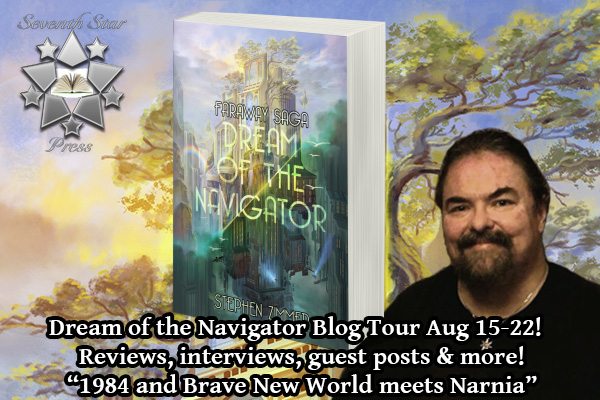
Dream of the Navigator Blog Tour

August 15-22, 2018


"1984 and Brave New World meets Narnia" in this exciting new young adult release from award-wining author Stephen Zimmer. Four main characters begin their journeys in the Faraway Saga, a tale that invites readers to explore infinite horizons! We are celebrating this new release with a full blog tour featuring reviews, interviews, video contents, guest posts and top ten lists! About the author: Stephen Zimmer is an award-winning author and filmmaker based out of Lexington Kentucky. His works include the Rayden Valkyrie novels and novellas(Sword and Sorcery), the Rising Dawn Saga (Cross Genre), the Fires in Eden Series (Epic Fantasy), the Hellscapes short story collections (Horror), the Chronicles of Ave short story collections (Fantasy), the Harvey and Solomon Tales (Steampunk), the Ragnar Stormbringer Tales (Sword and Sorcery), and the forthcoming Faraway Saga (YA Dystopian/Cross-Genre). Stephen’s visual work includes the feature film Shadows Light, shorts films such as The Sirens and Swordbearer, and the forthcoming Rayden Valkyrie: Saga of a Lionheart TV Pilot. Stephen is a proud Kentucky Colonel who also enjoys the realms of music, martial arts, good bourbons, and spending time with family.

Book Synopsis for Dream of the Navigator: "1984 and Brave New World meets Narnia" Cities have been replaced by technates. It is a world of soaring apartments, hundreds of stories high, where technology measures, monitors and rations to meet the needs of the greater populace. It is a world of drones, in the air and on the ground, and advanced robotic beings who carry out much of the harder labor, security, and even pleasure assignments. Those discontent, or who resist, are taken to Rehabilitation Centers, established after the embrace of the Greater Good Doctrine. For most, virtual realms, substances, and entertainment provide escapes, but for Haven, Cayden, Jaelynn, and Salvador, growing up in Technate 6 is a restless existence. A hunger for something more gnaws inside each of them. Discoveries await that open the gates to transcend time and space, and even new planes of existence. Nothing in their universe, or others, is impossible to explore. What was once reality, now seems like an illusion in a deepening experience. Begin the journey to Faraway, in Dream of the Navigator, the first book of the Faraway Saga!

Author Links: Website: https://www.stephenzimmer.com/
Facebook: https://www.facebook.com/stephenzimmer7
Twitter: @sgzimmer
Instagram: @stephenzimmer7

Tour Schedule and Activities
8/15 Sheila's Guests and Reviews https://Sheiladeeth.blogspot.com Guest Post
8/15 Jorie Loves A Story https://jorielovesastory.com Review
8/16  MyLifeMyBooksMyEcape https://mylifemybooksmyescape.wordpress.com Author Interview
8/17 Ravenous for Reads https://www.ravenousforreads.com Author Interview
8/17 Will Read For Booze https://www.willreadforbooze.com
8/17 The Sinister Scribblings of Sarah E. Glenn https://saraheglenn.blogspot.com/ Guest Post 
8/18 The Book Lover's Boudoir https://thebookloversboudoir.wordpress.com/ Review
8/19 Jazzy Book Reviews http://bookreviewsbyjasmine.blogspot.com VLog
8/19 Robin's Book Spot https://robinsbookspot.blogspot.com Review
8/20 Soul Meets Books https://soulmeetsbooks.wordpress.com Review
8/21 Sapphyria's Books https://saphsbooks.blogspot.com/ Guest Post
8/22 Literature Approved http://literatureapproved.com Review
8/22 Jorie Loves A Story https://jorielovesastory.com Video Interview 

Amazon Links for Dream of the Navigator

Print Version https://www.amazon.com/Dream-Navigator-Stephen-Zimmer/dp/1948042533/ Kindle Version https://www.amazon.com/Dream-Navigator-Faraway-Saga-Book-ebook/dp/B07CZTW4V6/
Barnes and Noble Link for Dream of the Navigator https://www.barnesandnoble.com/w/dream-of-the-navigator-stephen-zimmer/1128993419?ean=9781948042536

---

Tuesday, August 07, 2018

Business-Friendly

From Bullsugar.
Action must be taken to stop the poisonous discharges from Lake Okeechobee into the Caloosahatchee and St. Lucie Rivers. The red tide that kills fish and causes lung problems for people near the ocean has become an overwhelming summer problem in Florida. Elected state officials, including our governor, assign blame to the federal government. Elected officials in the federal government assign blame to Florida’s elected officials; the floodwaters from Lake O must go somewhere, or endanger the area around the lake. There’s plenty of blame to go around.

For years, there’s been a proposed Agricultural Area Reservoir to assist the Comprehensive Everglades Restoration Plan, which would direct more water south into the Everglades and Florida Bay, and rid the water of pollutants as well. The plans for this reservoir have been batted back and forth for at least a decade, but the Florida legislature has dragged its heels on actually building the thing. Acres keep getting removed from the plan and nothing’s being done.

Well, that’s not 100% correct. Florida has a ‘business-friendly’ government—the sort that has reduced the lunch ‘hour’ to 30 minutes and has made temp work a way of life. It also posts warnings to individual citizens about not using fertilizer, while allowing agribusiness to dump ‘nutrients’ (i.e. runoff) into Lake O. One rule for citizens, another rule for donors. The wildlife in the ocean doesn’t matter to some business owners nearly as much as the bottom line, and the same goes for the rivers and the people who live next to it. It’s a shame, but campaigns cost money.


https://www.floridaphoenix.com/2018/08/07/floridas-summer-of-slime-stuart-and-lake-okeechobee/
From the Florida Phoenix.
Then, there’s our ‘business-friendly’ federal government, which has spent the last couple of decades gutting the Clean Water Act. No teeth at the federal level, permissiveness at the local level. We know that the fish don’t matter. The manatees don’t matter. And a few lawsuits from wheezing citizens aren’t going to hurt the bottom line of political donors by much. So, the ‘nutrients’ pour into the lake, making it toxic. And when the rainy season comes, that water needs to go into the ocean. It’s deep and will eventually break up the pollutants, right?

But how business-friendly is it when dead fish litter the shore and the algae blooms are so toxic that it creates lung problems for the citizens – and, more importantly to our state officials, the tourists and retirees who buy those million-dollar condos? Hotels are losing customers, and real estate deals are falling through. Who wants to live near a stinky shore that makes you cough?

We’re coming up on election time, though. Our Esteemed Governor, running for the U.S. Senate, declares now that he has asked the government to ‘expedite’ the development of the reservoir. Lip service is being paid to the sad situation on both coasts by the Florida Legislature. These are often the same officials taking donations from Big Sugar and the same people that didn’t want to use the money from 2014’s Amendment 1 for its earmarked purpose – conservation.

It’s far past time to buy the land and clean the lake. It’s far past time to identify and support lawmakers that want to resolve this crisis (of all parties), and replace the ones that helped create it (Rick Scott is not a friend to the ocean). That’s what’s business-friendly.


---


Tuesday, July 24, 2018

Depression

Before we go any further, let me tell you that yes, I’ve seen someone for it. So put your mind at ease on that front. Some people suffer in silence, but I’m not one of them. If you don’t need to hear grumbling and whining, go elsewhere. I’ll understand; this is a depressing time in history.

Since the upending of my life in 2012 and the death of my father, I’ve been in a darker place. An emotional place where fewer people have my back, and a physical place where the living is uneasy. Shortly after the funeral, I became a liability and expense, leading to anger and behavior which I think less of myself for exhibiting. Moving saved my sanity, but I may have to return because, again, I am needed. Sadly, the trust is gone.

In the working world here, experience and age are liabilities. I was advised to leave jobs off my resume by temp agencies to conceal my age. A prospective employer told me that they could hire a temp to do a job that I knew, from working in a similar office in Kentucky, required specialized training and pulled down $40K as a starting salary. Businesses hire temps at low wages in Florida instead of ‘regular’ workers, and the cost of living where the jobs are located is very high. My wife and I both have long commutes and are frequently tired, plus I live in constant fear that my position will be offshored.

Then, there's just plain old depression. Based on my family history, I think I come by it honestly. Depression is an open wound, always bleeding, giving you surprise flashes of pain like the 'jump' shocks of a horror film. Even when I've been the happiest, I can't say I've ever experienced unalloyed joy.

So, I’ve been chugging along, doing my day job and paying my bills, but that’s all I have energy for most days. There have been bright points, like publishing anthologies and releasing the first novel of a series co-written with my wife, but the number of “What’s the use?” thoughts to overcome has been ridiculous.

Besides the “seeing someone” business I mentioned above, I’ve also used affirmations, visualizing my goals, etc. to improve my mood. I’ve discovered that it’s very hard for me to even picture success any more, or to believe that I’m still capable – or worthy – of attaining it. Once you’ve seen an ugly person in the mirror, it’s hard to forget or forgive. 

I must keep trying to climb out of the hole, though, even if I have so much more to regret at 50+ than I did at thirty. If you're depressed, you must keep trying, too.


Friday, June 29, 2018

The Price of Fine Living

Not my mobile palace.
I mentioned some time back that we moved into a gated community with an HOA. Overall, it's a nice place, so I will not name it here. Unfortunately, it has appearance 'standards' we must maintain. This is a bit challenging, since we have enough trouble finding energy and time at home to maintain the interior (think dishes, laundry, etc.).

Anyway, we got one of the letters from the HOA. We need to clean the outside of our mobile palace. I suppose it's to be expected, since the people around us are very anal-retentive about their own properties, but I think it should be illegal to demand this sort of outside labor in Florida in late June.

So far, we have learned the following about cleaning the exterior of a mobile home:

  1. Use a pressure washer. It's faster and more effective. Way more effective. I would use it to remove my freckles, but I think it would take the rest of the skin off, too.
  2. Use something with bleach. Fuck the vegetation. If it worries you, remind yourself that it's going to get diluted fast when you turn the pressure washer on it.
  3. Wear glasses or safety goggles. Also, be careful when edging a pathway with a pressure washer. There's blowback. Never mind how I know this.
  4. Dawn works better at removing grime than laundry detergent does.
  5. Your neighbors, the ones you thought were anal-retentive, will come and ask if you got a letter from the HOA, too.

The aftercare for this endeavor involves cortisone, Benadryl, and Advil. Lots of Advil. But at least we can see the original color of our awnings again.


Saturday, December 16, 2017

Women! How to Spot a Bogus Facebook ID


Update! I just got a friend request from someone with pics that advertised the 2010 Census. They also showed him with bumper stickers implying that he was running for office. I researched the name and discovered that the real guy was sentenced to prison earlier this year. Yes, the pictures match. Either he's looking for a prison pen pal, or someone's spoofing him.

This guide is primarily for women, although gay guys might get some of these invites, too. Men, if you have your own list, feel free to comment.

The past year has brought a flood of friend invites from Facebook IDs of unknown provenance and questionable intentions. Many are from phishers, catfishes, and scam artists. They can also come from exes and the stalkerish set, but no one seems interested in stalking a fat middle-aged lesbian of modest income.

Some of the 'tells' of a fake Facebook ID:

  • Timeline has a few posts, period, and there are no friends or interests listed. Person is at least an 8 and you are a 5 or lower.
  • Profile photo is of Hugh Jackman, and profile name is Hugh Jackman. Yes, I got this.
  • Profile and name are of someone you are already friends with. Every once in a while, someone needs to create a new ID, but try contacting your friend first to be sure.
  • USA military and widowed. Logic would suggest that the soldiers have a more dangerous lifestyle than their wives, but not with this bunch. Bonus points if the uniform displays a different name than the Facebook name, or is of foreign origin.
  • Name is Western but consists of two first names, or surname used as first name. I've seen it happen in real life, but it's not common. Reveals a poor grasp of western naming conventions.
  • Picture is of lily white guy "from Texas" (a favorite state-don't ask me why), but celebrity and sports favorites are Nigerian or Ghanaian. I understand Macedonia is also popular.
  • Divorced or widowed guy was born in Texas, educated in Europe, and now works "in oil" in the UAE. Listed here because I've seen this several times. I guess this is to reel in gold-diggers. Hmm.
  • Divorced or widowed guy was born in London, educated in Europe, lives in Texas, claims to be a physician but writes posts like "I lov music,i like siging.All my frid has gon to de stidio,but i dose not,just becaze of money money". Student debt is a killer, I guess.
  • Picture is of gorgeous African-American man holding a rose, all posts contain romantic lines or praise The Lord. All his friends are women. Real or fake, he's going to break your heart.

If you do friend someone and aren't sure after the fact, use some of the standard cautions for the Internet: don't click on any links they send you, give them your personal information, and Google anything that sounds like a scam for money. Also: take another look at their profile to see if any new red flags appear. Real people usually have a lengthy timeline with less-than-relevant content, and tend to like at least one thing you don't. If the cupboard is bare, tread carefully.

------

ShareThis