Showing posts with label humor. Show all posts

Wednesday, July 13, 2022

Debra H. Goldstein: Balancing Humor in Murder Mysteries

Blood, gore, sex, violence, shady characters, and, of course, a dead body, are givens for murder mysteries – except when the mystery is a cozy. Then, the blood, sex, gore, and violence are left off the page. Instead, the plot and characters must be complex enough to engage the reader in wanting to know whodunit and it helps to add a bit of humor.

Usually, a cozy mystery involves a small town or confined setting, an amateur sleuth, quirky sidekick characters, a job or interest that is craft or cooking/baking related, a cat or occasionally a dog, and the aforementioned lack of blood, gore, sex, and violence on the page. Unlike the building sense of tension in suspense or thrillers, humor is used as a means of easing the reader from high pitched moments. It also often helps readers identify the characters.


When one thinks of humor, one thinks funny; however, in a cozy mystery rather than being an “ha, ha” moment, the humor may come across softly from the way a character uses a phrase, dresses, gives another character “that look,” or behaves. In my Sarah Blair books, I incorporate humor in several diverse ways.


Sarah Blair is not an expert at cooking, baking, or crafts. She is a woman who is more frightened of the kitchen than she is of murder. When pressed to prepare a recipe (something all cozy mysteries must include), she uses premade ingredients. In One Taste Too Many, the first in the series, Sarah prepares Jell-O in a Can from Jell-O and Dole pineapple rings. Even though the end product is quite nice to look at, the name and concept of the recipe provokes a chuckle.


In newly released Five Belles Too Many, the craziness that occurs behind the scenes of a reality TV show, where contestants are vying to win the perfect Southern Wedding, provides a framework for laughable moments. Because the show’s taping is being done in Alabama, Southern stereotypes are a basis for various aspects of humor.


The characters create the first dimension of humor. Of the five finalist couples, two represent the famous football rivalry between the University of Alabama and Auburn University; one matches the stereotypical thoughts often expressed about the South (think Jethro and Elly Mae from The Beverly Hillbillies); one, simply to mix up expectations, is humorous because they want a Day of the Dead wedding; and, the final couple, Sarah’s mother, Maybelle, and her beau, George, represent those over sixty who are unfiltered but wise. Maybelle’s observations and understanding of why George and she are finalists create several outright and occasionally bittersweet instances of humor.


The idea that Sarah, who is twenty-eight, must be her mother’s chaperone twists the expected dynamic of chaperoning. The fact that the TV show is forcing the contestants and chaperones to stay at the bed and breakfast owned by Sarah’s greatest nemesis, Jane, establishes conflict for the characters but humor for the readers. Although it isn’t funny when the show’s producer is killed and Sarah finds Jane leaning over the body, Sarah’s inner conflict between whether to help Jane or not goes to the root of her characterization, but also offers me the ability to put funny thoughts in Sarah’s head.


While the cozy set-up provides numerous moments for humor, it is important that these scenes not over-shadow the whodunit. Cozy readers want a fast paced, fun book, but too many “funny” scenes can easily become monotonous and dull. That’s why there must be a balance between how much of the book is devoted to set-up, the crime, the investigation, serious moments, and things that make the reader chuckle.


For a chance to win a copy of Five Belles Too Many, tell me, what makes you laugh when you read a cozy and whether the Five Belles cover telegraphs that there will be humor in the book?

Five Belles Too Many

When Sarah Blair’s mother is a finalist to win the perfect Southern Wedding in a reality TV show competition, Sarah is pressed into service as Mother Maybelle’s chaperone. After the show’s producer is found dead, with Sarah’s greatest nemesis kneeling by the body, Sarah must find the true killer before any other contestants or crew are permanently eliminated 

Buy or gift a copy of Five Belles Too Many from: 

Amazon 

Barnes & Noble

Your favorite indie bookstore.


Judge Debra H. Goldstein writes Kensington’s Sarah Blair mystery series (Four Cuts Too Many, Three Treats Too Many, Two Bites Too Many, and One Taste Too Many). Her short stories, which have been named Agatha, Anthony, and Derringer finalists, have appeared in numerous periodicals and anthologies including Alfred Hitchcock Mystery Magazine, Black Cat Mystery Magazine, Mystery Weekly, Malice Domestic Murder Most Edible, Masthead, and Jukes & Tonks. Debra served on the national boards of Sisters in Crime and Mystery Writers of America and was president of the Guppy and SEMWA chapters. Find out more about Debra at https://www.DebraHGoldstein.com .

You can also connect with Debra at:  

Facebook: https://www.facebook.com/DebraHGoldsteinAuthor

Twitter: @DebraHGoldstein 

Instagram: https://www.instagram.com/debrahgoldstein/ 

Bookbub: https://www.bookbub.com/profile/debra-h-goldstein


Wednesday, September 07, 2016

Under the Radar

This has been a very quiet year for us in terms of announcements about the books we've published or stories we've written. We've been dealing with home repairs (free air conditioning should be a constitutional right in Florida), getting involved with our new Sisters in Crime chapter, and facing our first official hurricane in the Sunshine State. You can assume from this post that we survived Hermine. It was odd, though, to get time off for bad weather in the summer.

Oh, and we had a vacation. A real vacation, the first in several years that was longer than a three-day weekend. Gwen cooked many lovely things, we swam daily, and we also got to read for pleasure, something that we don't get to do as often as we'd like.
During this quiet summer, though, after the release of Strangely Funny III, Gwen and I were very busy, but not so you'd notice on our business page. We were finishing our first novel together. You're probably wondering how we accomplished that: she's a plotter who writes very serious, often dark, mysteries set in the 1870s; I'm a snarker with a short attention span, and most of my stories are set in the present day. I think you'll like our compromise: a mystery set during the 1920s Florida land boom. It has poison, car chases, mobsters, and some serious hangovers. Oh, and one Gertrude Stein book.

Murder on the Mullet Express will be coming out in early 2017.


---


Sunday, October 11, 2015

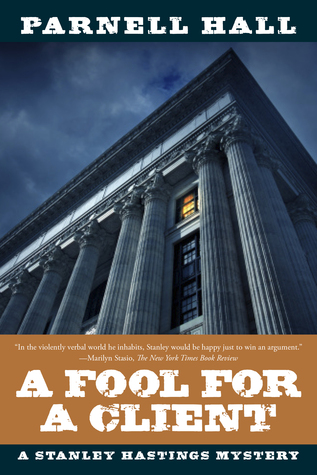
Parnell Hall: A Fool for a Client (Stanley Hastings Mystery #20)

"Tell me about the girl with tits."
"How'd you know about the girl with tits?"
"There's always a girl with tits. She may not have anything to do with the case, but you manage to make her important."
Stanley Hasting's boss, Richard Rosenberg, is in big trouble. Richard's girlfriend, a law clerk, has been murdered and the negligence lawyer is the prime suspect. Richard is the fool because he's decided to represent himself. Why? Because he doesn't trust lawyers: they're sleazy pond scum, and he's proof of that. He wants Stanley's assistance, but it's going to be hard: he was the last person seen with the victim, DNA proves he had sex with her, and his fingerprints are on the murder weapon.

The victim, Jeannie Atkins, was assigned to a global banking trial, which seems unconnected to anything that would have led to murder. She clerked for the judge, and usually judges take a dim view to their assistants being killed. Stanley hopes to find a connection, though, and becomes a regular spectator at the banking trial, which is just as exciting as you think it would be: not at all.

Our hero perseveres through the boredom, though, talking to jurors, alternates, a clerk with romantic ideas of what detectives do, and the long-suffering judge for the trial. He also finds "the girl with tits," Juror Number Twelve. Stanley discovers that she was an alternate promoted after someone else was excused. He procures the address of the excused man and pays a visit - to a dead body.

I've often wanted to see Richard Rosenberg at work, and this book doesn't disappoint. Most of the cases he takes involve trip-and-fall or accidents on city property. Half the people at court are scared of him, and we learn why. He turns down the probable cause hearing and goes straight to trial. He accepts all candidates for the jury without questioning them. He insults the expert witness. He insinuates that no one is telling the truth about when he left the victim's apartment because the security guard slunk off early and his limo driver was padding the time for higher pay. He makes Denny Crane look like a paragon of discretion.

None of this is going to matter, though, because the evidence is against Richard. He was the last person seen with the victim, his bodily fluids were present at the scene, and his fingerprints are on the murder weapon. He has no clue who the murderer is. Stanley's occasional ally, Sergeant MacAuliff, is of the opinion that Richard will only escape jail if he can 'pull an O.J.' and create reasonable doubt.

Will Rosenberg dream up a great strategy, or will he go to prison? Will Stanley find the real killer after all, or go to jail after giving grief to the judge in the banking case one too many times? Read A Fool for a Client to learn the answer to these and other relevant questions, including how often a detective's wife has to explain to her husband what the information he's discovered implies for the case.

I greatly enjoyed the book, but you may need to keep a scorecard for some of the conversations. The repartee zips back and forth very rapidly with few conversation tags. It's still very funny. I was also pleased to see Alice (Stanley's wife) again, who creates order out of her husband's eccentric observations.

Disclosure: I was given an ARC of this book to read and review. You can also see this review at Goodreads.com .

Thursday, June 04, 2015

David Dunwoody: A Grin in the Dark

I'd like to welcome our guest blogger today, David Dunwoody!

Born in Texas and currently wandering somewhere in Utah, David Dunwoody writes subversive horror fiction including the EMPIRE series, HELL WALKS, THE 3 EGOS, and the collections DARK ENTITIES and UNBOUND & OTHER TALES. His fiction has been published by outfits such as Gallery, Shroud, Dark Regions, Belfire, Evil Jester, Permuted and Chaosium.

In this post, Dunwoody takes on a subject near and dear to my heart: humor in horror fiction.


About a decade ago when I was first published, I wanted to be known for dark, dark fiction. An eight ball at the bottom of the ocean at midnight, that kind of dark. I wanted readers to come away from my novels feeling drained. And I still do, but I’ve come to realize that there’s such a thing as balance, even in a realm of writing where doom and gloom pervade. Especially then.

There are few involuntary responses which we all share. Two are the belly laugh and gut-twisting dread. Though they may seem strange bedfellows at the onset, humor and terror often complement one another quite nicely in fiction. When thinking back over some of the darkest, scariest works I’ve ever read, I can’t help but notice that many feature moments of black humor and even laugh-out-loud bits. Some of the funniest people I’ve ever met are horror writers (they’re also by far the most normal, but that’s another blog). So how do scares and chuckles work together without being jarring?

Sometimes the jarring effect is exactly what works. The levity of a humorous moment, followed by a radical shift in tone, strikes one hell of a contrast. That may sound like the anatomy of a cheap scare, but I think it’s all in the execution. Perhaps the main thing to consider in such a case is whether you’re doing it for the story or the future reader. Are you in the moment? You’re not a short-order cook, after all and you, of course, write for yourself first.

While you don’t want to manufacture forced scares in service to your prospective audience, you don’t want to stand in your own way either when it comes to humor. Follow your gut on these questions of tone. Most of my novels are apocalyptic in  nature and there are many tremendously dark moments, unrelenting moments when I am unable to step back and catch my breath. When they have their place, bits of levity can be a welcome respite and a chance to explore other aspects of my characters.

With regard to characters, humor can also work well when following terror, or a scene of intense sadness or hopelessness. In life, we often deal with such feelings by cracking wise. It’s a coping mechanism and one of the things that makes us human. It makes characters human too. (Or let’s say relatable, for those non-human ones.)

Just as fear takes different forms, and encroaches by varying degrees, so too does humor. From outright absurdity, to inside jabs between friends, to the all-too-true sentiment that elicits a sardonic smile, there is a lot to work with.

I’d never say that everyone should always try to inject humor into their dark fiction – but I will say that, if your muse is suggesting you do it, don’t shy away. Don’t worry that it’s going to water down the product. Follow your gut! A grin in the dark only makes its surroundings that much darker.


Learn more about David Dunwoody's work at http://empirenovel.blogspot.com/ . See the trailer below to learn more about The 3 Egos.


Sunday, November 16, 2014

Current Distraction: Comedy

Some introductory bullshit: it was a stressful summer. We moved to Safety Harbor, which is a wonderful place, but we have to support ourselves now – not just lot fees and monthly expenses, but debts accrued during our years in Kentucky. You know, back when Gwen and I both had full-time jobs and where the cost of living was so much lower? I enjoy having our own place again so much it’s embarrassing, but I also worry a lot. This is an insecure job market.

Then, Robin Williams killed himself. I didn't expect it to hit me as hard as it did, but I'm still sad about it. His work was so full of zaniness and optimism, which was a tonic to my Eeyore-like nature. So, I decided to see if I could hear some of his bits on Pandora. Yes, I could, and was introduced to a large number of other comedians, too. Below are some of my current favorite tracks. If you listen to comedy,feel free to comment or make suggestions.

Dan Cummins – Here Come the Spoons
Jeff Dunham – Buddy the Peeping Dog
-          Not part of his puppet act, just a great story.
John Pinette – France and Italy
-          Also died far too young.
Craig Gass – Gene Simmons is Going to Kill Me
-          I wouldn’t want to hear this track over and over, but it is horribly funny the first time.
Louis CK – The Time I Thought I Was Going To Die
-          Bad airplane landing story #1
Gabriel Iglesias – Magic Mike Story
-          I love Fluffy!
Matt Braunger – Clown Pub Crawl
Bobcat Goldthwait – The Voice of Death
-          Bad airplane landing story #2.
Ben Bailey – Road Rage
Craig Ferguson – Hotel Porn
Robert Schimmel – My Daughter’s Computer
-          Funnier if you remember the early days of AOL.

---

Thursday, August 28, 2014

Strangely Funny II Authors: Meet John Lemut!

John Lemut, author of “Labor Eco-nom-nom-ics” lives in Wisconsin. He spends his time watching too much TV, brewing and drinking beer, writing, editing, and marrying people. In addition to showing us how zombies can improve the economy, his short stories appear in the anthologies First Time Dead, Say Goodnight to the Bad Guy, Vampires Aren’t Pretty, and Night Gypsy: Journey into Darkness. His website is johnrambles.com.

When did you know you wanted to become a writer?
I read The Catcher in the Rye when I was in the 4th grade. I didn’t think, “I can do that…” I thought, “I want to do that…”

How did you come up with the idea for your story in Strangely Funny II?
I first intended “Labor Eco-nom-nom-ics” as a fairly direct homage to Gabriel Garcia Marquez’s “A Very Old Man with Enormous Wings” – one of my favorite short stories. I thought the concept of a zombie nobody cared about, in place of an angel, had potential. As I developed it, my preconceptions of what I wanted to happen in my story changed significantly, and while it may no longer bear much of a resemblance to Marquez’s story, I certainly owe its existence to the Marquez story.

Do you think certain genres lend themselves to a humorous twist?
I definitely think some of the horror sub-genres (zombie and vampire fiction, in particular) are rife with potential for humor. In all honesty, zombies are pretty absurd. It doesn’t mean I don’t love them, but it also doesn’t take much of a tilt in perspective to find the humor there. I have a sardonic way of looking at most things in the real world. I find mixing zombies in there actually helps mask my attitude a bit.

Plotter or pantser?
I’m a little of both. Usually I’ll work from at least a basic outline, but one of the most enjoyable aspects of writing is a story taking shape in ways you didn’t anticipate. Then I’ll completely ignore the outline where appropriate.

Which author do you most admire, and why?
I swear this isn’t a shameless plug for a friend, but I most admire Eric Pollarine, a self-published author I’ve done some editing for. First off, Eric writes stories that he wants to write, and I admire that confidence. His ability to write – to push through all the mental blocks and doubts, and get words on the screen – is a gift. I have been fortunate to have been a small part of his process and have learned so much from that. I take inspiration from his work ethic, and value the opportunities I’ve had to work with him.

Okay, so you're an author. What do you enjoy reading?
I broke the habit of only reading authors with names everyone recognizes several years ago. Now I enjoy finding stories from independent publishers and self-published authors that I think will interest me. They aren’t necessarily going to be the most polished books you’ll find, but for originality, edge, and sensibility, few bestsellers compare. Genre-wise I tend to read horror (mostly zombie horror), sci-fi, bizarro, humor, and thrillers – usually my favorite books have been blends of more than one of these. Kevin Hearne’s Iron Druid series is an excellent example.

Thank you for talking with us!

Strangely Funny II is now available in print or Kindle from Amazon, plus it is also available on Smashwords. Our Goodreads Giveaway only has a couples of days left, so if you want in, now's the time to enter!

Wednesday, August 27, 2014

Strangely Funny II Authors: Meet Omar Sakr!

Omar J. Sakr is an Australian writer and poet with a Masters in Creative Writing from the University of Sydney. His short story 'Aftertweet' was selected as part of the Twitter Fiction Festival, and his poetry has featured on Cordite Poetry Review, as well as the ABC. He has poetry forthcoming in Meanjin and Carve Magazine. You can follow him on Twitter @OmarjSakr or on his website http://omarsakr.wordpress.com .

His story in Strangely Funny II, "Caryard Jack", tells the story of a necromancer awakened after several centuries into the modern world. Unfortunately, his ex still remembers him, and not fondly.

When did you know you wanted to become a writer?
I first tried my hand at writing when I was about 11, and I’d just finished reading Lord of the Rings. I can’t remember what I wrote, except that it was undoubtedly pure plagiarism. Put off by that, it wasn’t until I was 15 that I wrote again. I was hit by a story out of the blue, and sat down to write it.  I finished it in one sitting, hand cramped, page full of my ungainly blue scrawl, and that’s when I knew.

How did you pick the genre/setting/era you (usually) write in?
I like to think I didn’t choose it at all – that it chose me. Truthfully, I had the choice all but dictated to me. When I was about 10, my step-father bet me $10 I couldn’t sit through an entire novel. The novel he chose was King Arthur and His Knights of the Round Table by Roger Lancelyn Green. It had magic, kings, queens, knights and witches, and from then, I was lost to this world, and always in another. The next few books I read were largely picked by my mother, in Harry Potter, and Stephen King’s Rose Madder. These are the books which shaped my imagination, a mix of magic, medieval England, and horror.

How did you come up with the idea for your story in Strangely Funny II?
I was at work, drudging away, trying to overcome a mental block to a story I was in the middle of writing. I loved the concept, and thought the beginning of it was some of the best writing I’d done. Consequently, I began to treat it too preciously,  and was worried about ruining it. I was stuck – doubly so by being at work – but had the writing itch, so I opened up a page and just started writing the first thing that came to my head. It says a whole lot about me that the first thing I thought of was an ancient murderous bisexual necromancer, but there you have it.

Do you think certain genres lend themselves to a humorous twist?

Life lends itself to humour; I don’t think there’s a single genre or medium out there that shouldn’t be layered with humour. The universe is an enormous cosmic joke and if I wasn’t able to laugh at it every day, I don’t think I’d manage to get by. That said, any subject dealt with pompously – my dear beloved fantasy, I’m looking at you – ought to have the mickey taken out of it, and no one is more conscious of that then fantasy writers today.

Plotter or pantser?
Pantser. I write as it comes to me, in flashes of inspiration (read: delusion), otherwise I’d likely be too bored if I knew the entirety of it from the outset.

Which author do you most admire, and why?
This is an impossible question to answer. I admire different authors for different things – their prose, mastery of structure, brilliant concepts, etc. If we’re talking in general, I’d say right now the author I admire most is Patrick Rothfuss, for his inspiring charitable work with Worldbuilders.

Which place that you haven’t visited would you most like to go?
Turkey, my ancestral homeland.

Okay, so you're an author. What do you enjoy reading?
Fantasy, Science Fiction, and Horror predominantly, although if the past year or two is any indication, my current loves are poetry and literary fiction. Above and beyond everything else, short stories remain my favourite reading type. I also love graphic novels and comic books.

Thanks for talking with us!

Be sure to check out Omar's story in Strangely Funny II, now available in print and e-book formats on Amazon and Smashwords. And don't forget - we're also giving away three free copies of the book on Smashwords! The deadline is August 31, so don't delay!

Thursday, August 14, 2014

Strangely Funny II Authors: Meet F.R. Michaels!

Today, we say 'hello' to F.R. Michaels, author of "Dead People, Seriously". He's a multitalented guy. His first short story, “Mrs. Edgecliff”, appeared in Alfred Hitchcock’s Mystery Magazine and received an honorable mention in The Year’s Finest Fantasy and Horror Sixth Annual Collection by Ellen Datlow and Terri Windling. Another short story, “Fluf”, appeared in Haunts magazine and was made into a short film that was shown at the Sundance film festival. He also does artwork and illustrations that have appeared in various fan publications and small press works.

When did you know you wanted to become a writer?
Ever since I found out that no one was writing the stories I wanted to read. I think I was 8.

How did you pick the genre/setting/era you (usually) write in?
Nothing gives a person the same thrill as a good scary story. As for the setting, I have a collection of fictional towns based on Long Island's north shore where I grew up; "Dead People, Seriously" takes place there.

How did you come up with the idea for your story in Strangely Funny II?
There are a lot of zombie stories out there where the undead are a plague of mindless relentless monsters... but what if a zombie was raised from the dead and was the same person he was during his life? Multiply that by a whole graveyard full of people, throw in a couple of college frat boys who should not be playing with black magic, shake vigorously, and "Dead People, Seriously" is what came out.

Do you think certain genres lend themselves to a humorous twist?
I think you can inject humor into any genre. What I like about humor in a horror setting is the horror can build such a storm head of tension and the humor can release it. Think American Werewolf in London.

Plotter or pantser?
Oh, I'm not nearly organized enough to be a plotter. Come to think, I'm not even organized enough to be a pantser. But closer to pantser than plotter, definitely.

Which author do you most admire, and why?
Mary Wollstonecraft "Scary Mary" Shelley. She wrote Frankenstein when she was 19, on a bet, published it anonymously, and wrote the very first science fiction novel and one of the scariest stories in existence even today, back in a time when women weren't even considered writers. That's hardcore.

Which place that you haven’t visited would you most like to go?
I'm not that much of a traveler. There are places in my own head I don't like to go.

Okay, so you're an author. What do you enjoy reading?
I love old school: Poe, Stoker, Shelley, LeFanu, Saki, Bierce, Machen, Blackwood, Lovecraft, Robert Louis Stevenson, C.S. Lewis, Tolkien, Arthur Conan Doyle, etc - and fall back to them periodically. That being said, I think there's a small renaissance going on right now in modern speculative fiction, with small press and e-book publishers leading the way. There is an entire roster of new and emergent authors who are breaking some exciting new ground. I'm gobbling up as much of that as I can, and liking what I find.

Thanks for your time!!!
You're welcome. Can you untie me now...?

Frank Raymond Michaels (F. R. Michaels) is actually a very nice, normal person who happens to like weird stories and scary artwork. No, seriously. He lives on Long Island with his wife, daughter, several cats, a small dog, a big dog, and whoever happens to be in his basement at the time. He writes horror and dark fantasy. He is currently working on several short horror fiction and artwork projects and a Swords and Sorcery novel.

Meanwhile, you can enjoy "Dead People, Seriously" in Strangely Funny II, now available on Amazon and Smashwords.

Monday, August 11, 2014

Strangely Funny II Authors: Meet B. David Spicer!

Today, we meet B. David Spicer, author of "Two Martini Lunch", which appears in Strangely Funny II. Mr. Spicer writes crime fiction, science fiction and horror fiction and occasionally writes scripts for independent comic book publishers. His short fiction has appeared in several anthologies and journals throughout the country and overseas. In "Two Martini Lunch", we meet a vampire who prefers a specific... taste to his blood.

When did you know you wanted to become a writer?
By the time I turned twelve I’d read The Chronicles of Narnia and The Lord of the Rings, and after that I knew I wanted to write. Unfortunately, it took over twenty years from that point for me to get serious about writing.

How did you come up with the idea for your story in Strangely Funny II?
When I was in high school I played a role-playing game with my friends called Vampire: The Masquerade. One of the characters I played was an alcoholic who got turned into a vampire, but still wanted to get drunk, which led to some hilarious situations. Something my dad said reminded me of that character, and I knew right then what I wanted to write about.

Do you think certain genres lend themselves to a humorous twist?
Absolutely, especially horror. The things that scare us are often patently ridiculous when you look at them closely. Take zombie movies for instance. Why would a dead person, even one who could still walk around, need to eat? Are they digesting all those brains? Do they use ketchup or mustard? What would a zombie do if it got an upset stomach?

Plotter or pantser?
Definitely a pantser. I start with an idea and let the story grow organically. I think trying to force a story to fit inside a pre-plotted framework hampers the growth of the story. If I’m writing a scene and get a great idea for a plot-twist that’ll take the story off in a completely different direction, I run with it. Tolkien once said that The Lord of the Rings “grew in the telling,” which I’ve always taken to mean that it grew well beyond his original conception of the story and went off in a direction he hadn’t thought of at the beginning. That’s how I write, and I can’t imagine doing it any other way.

Which author do you most admire, and why?
Well, I’ve already mentioned how Tolkien influenced me from a young age. Reading The Hobbit for the first time was a turning point for me, one that changed me forever. Reading went from being a fun hobby to an outright obsession, and I began to create stories of my own in my mind, and it wasn’t long before I wanted to write them down. Tolkien instilled in me a love of fantasy and the fantastic, and more importantly a love of reading, and eventually writing. I wouldn’t be a writer today if it hadn’t been for Tolkien.

Okay, so you're an author. What do you enjoy reading?
During my formative years I read mostly fantasy series, Tolkien, C.S. Lewis, David Eddings, Tad Williams and the like. In high school I found Stephen King and read him obsessively for a few years. As I’ve gotten older I’ve found myself drawn to Ray Bradbury, Harlan Ellison, and Charles Dickens. Within just the last five years I’ve read almost all of Agatha Christie and Dorothy L. Sayer’s mysteries. Likewise I’ve delved into the hardboiled style mysteries of Raymond Chandler and Dashiell Hammett. I think my future holds a few mystery stories.

We'll be looking forward to those! Thanks for talking with us!

Be sure to check out B. David Spicer's contribution to Strangely Funny II. He also has several other stories out now: the Torched anthology by Nocturnal Press Publications, Dark Light Book Four by Crushing Hearts and Black Butterfly Press, and The RudderHaven Science Fiction and Fantasy Anthology II by RudderHaven Publications.


Wednesday, August 06, 2014

Strangely Funny II Authors: Meet DJ Tyrer!

Once again, we invite DJ Tyrer to an interview. When we last met him, he had a story in All Hallows' Evil. We learned then about his fascination with the King in Yellow and his involvement with The Yellow Site wikia. This time, he's come to the funny side and joined us for Strangely Funny II!

When did you know you wanted to become a writer?
I've always wanted to be a writer as far back as I can remember and have written stories ever since I could write. I grew up surrounded by books, so writing has always been part of my life.

How did you pick the genre/setting/era you (usually) write in?
A lot of my fiction falls within the boundaries of horror and I also write quite a bit of humour (because if you push horror too far it becomes comedic and if you push humour too far it becomes horrific). However, I've never consciously chosen to write in a specific genre or style, as I like to experiment and prefer to let my writing go where it will rather than force it to conform. I think I've confused a people when they discover that I write quite divergent fare!

How did you come up with the idea for your story in Strangely Funny II? 
The idea for Costumed Hero popped into my head when I was attempting to come up with a horror story for a Hallowe'en-themed anthology. As I thought through all the aspects of the holiday the title for this story came to me. Initially, I played with various permutations of partygoers dressing up as superheroes to no success when the plot just came from nowhere.

Do you think certain genres lend themselves to a humorous twist?
Horror is easy to blend into humour, as they are effectively either ends of a sliding scale. If you push horror too far it ceases to be scary and becomes humorous in its grotesque absurdity, whilst humour pushed too far ceases to be funny and becomes horrific. Paranormal fiction that isn't intended to be horror per se (such as that which my story draws upon) is also ripe for humour as it can easily be pushed into absurdity. It's much the same for other genres – push them through the unpleasant until you find yourself laughing rather than crying or cringing – it's just that the darker genres are already close to that point.

Plotter or pantser?
In almost every area of my life I like to have everything planned out. However, when it comes to plots, that's not generally true. Even when I write a plot down I usually treat it as an aide memoir of points to include rather than a map – when I have crafted a detailed plan, it usually gets binned before the halfway point as developments render it irrelevant! However, whilst I sometimes go into a story 'blind' having no idea where it's going – or perhaps knowing how it should end but having no idea how it'll get there – I frequently have a constantly-changing mental map of the plot. Or, to be it another way, a bit of both!

Which author do you most admire, and why?
I struggle with requests for my top ten favourite authors/books, let alone whittling them all down to one! Different authors have different strengths, so it's difficult to put one above the other in terms of quality or importance.

Which place that you haven’t visited would you most like to go?
I would love to visit the archaeological sites of Egypt and the Middle East, as the ancient world is one of my passions.

Okay, so you're an author. What do you enjoy reading?
I read a wide variety of fiction from different genres, but the authors I return to most often are the Bronte sisters, Jane Austen, Robert W. Chambers, HP Lovecraft, JRR Tolkien, Weis & Hickman, Arthur Machen, Clarke Ashton Smith, CS Lewis, Lewis Carroll and Oscar Wilde. Other Cthulhu Mythos fiction and the various Doctor Who novels also feature regularly and I also enjoy reading JK Rowling, Clive Cussler and James Patterson. A nostalgic fondness for the Nancy Drew series and the Worst Witch stories of Jill Murphy never fails to baffle some!

I also read a lot of non-fiction, especially history, which has always been an obsession of mine.

Thanks for talking with us!

DJ Tyrer's story The Promised Messiah can be found in the new Steampunk Cthulhu anthology from Chaosium, whilst his sorcerous fantasy Kamilda of Ys can be found in the new Tales of the Black Arts anthology from Hazardous Press, both of which are available now from Amazon. You can learn more about DJ and his publications from his blog at http://djtyrer.blogspot.co.uk/ .

Strangely Funny II is now available in print or Kindle from Amazon, plus it is also available on Smashwords. You can also get a shot at a free copy right now via our giveaways!

Tuesday, August 05, 2014

Strangely Funny II Authors: Meet Marc Sorondo!

Today, I introduce you to Marc Sorondo, author of "The Trouble with Decorations". The story involves a decorative item/toy that didn't exist when I was young (I would have flushed that ratfink). This particular specimen, however, is more gifted than the ones available in stores.

When did you know you wanted to become a writer?
I started writing stories when I was a kid. I want to say junior high, but it could have been freshman year of high school. I was hooked right away and based my college choice on the writing program it offered.

How did you pick the genre/setting/era you (usually) write in?
My stories are all over the place: distant past to sci-fi future, and all over the world (and universe in some of the science fiction). I go where the stories seem to want to go, but I do get some extra enjoyment out of setting stories in places I’ve actually been and know. I love adding little details about settings that are completely accurate but that only someone who has been to a place would recognize as being real.

How did you come up with the idea for your story in Strangely Funny II?
The toy “Elf on a Shelf”…it creeps me out. A little elf doll that comes alive and spies on you. Come on, that thing is a horror tale already without knowing it.

Do you think certain genres lend themselves to a humorous twist?
I think a humorous twist can work with any genre.

Plotter or pantser?
Hybrid. I tend to let ideas marinate for a long time in my head before I actually sit down to write them. I’ll spend months or even years letting an idea ripen and jotting down notes on scraps of paper. Then, when I write a story, I've got some scenes that are already written and vaguely in order, but with a bunch of emptiness in between that I fill in as I go.

Which author do you most admire, and why?
I’m going to cheat a bit and name two. For pure storytelling skill, I love Stephen King. The man can weave an insanely layered and complicated story without it ever lagging for a paragraph, but he can also compose a short tale that packs a tremendous punch. He’s a master of both the long and short form. For the poetic nature of his prose, I envy Ray Bradbury. There is a quality to his writing that is unique to Bradbury…it’s got a haunting simplicity and a rhythmic aspect. His shorts and his novels all feel like long narrative poems.

Which place that you haven’t visited would you most like to go?
I’ve got a long list of places that I’d like to see. At the top, battling for primacy are Spain and Germany.

Okay, so you're an author. What do you enjoy reading?
Right now I’m working on a Ph.D. in History, so I read a lot of history and science history. In between semesters, I load up on fiction. I’ve already mentioned my love of King and Bradbury. Some of my other favorites are Clive Barker, Dan Simmons, Joe Hill, and Robert McCammon. There are a million others who I admire and probably should name, but I’m trying to keep this short.

Thanks for talking to us today!

Marc Sorondo lives with his wife and children in New York. He loves to read, and his interests range from fiction to comic books, physics to history, oceanography to cryptozoology, and just about everything in between. He's a long time student and occasional teacher. To learn more about Marc's fiction, including his novella Aurora: Dawn of a New Era, visit his site at:

Monday, August 04, 2014

Strangely Funny II Authors: Meet David Bernard/Goudsward!


Aaaannnnd our press is back with Strangely Funny II, the followup to last year's collection. It's already available in print and e-book formats on Amazon and Smashwords.

I'd like to introduce you to an author who has appeared in both anthologies. David Bernard is the pen name of David Goudsward, a native New Englander who now lives (albeit under protest) in South Florida, a paradoxical place where, when temperatures drops below 60˚, locals break out parkas to wear over their shorts and sandals. Fans and detractors alike will enjoy the Florida-set "Goldy Luke and the Three Gators".

When did you know you wanted to become a writer?
I started writing back in 1975. I was in a local theatre group and started correcting errors in the script – I’m not talking grammar. I’m talking about dialogue so bad it confused the word ancestor for descendant. That was my “I can do this, and I can do this better” moment. I immediately set out with a cohort and we wrote the production for the next summer’s children theater group. More or less wrote plays through high school, switched to radio plays when a friend started a pirate radio station. I flirted with an internship at a newspaper and stayed with non-fiction after that. I didn’t return to fiction until 2010 at the insistence of my brother. By that point, I already had seven books out on non-fiction topics.

Do you think certain genres lend themselves to a humorous twist?
I think most genres lend themselves to humor, but I also think there’s a difference between humor and parody. I rarely find making fun of a style lends itself to hilarity unless it’s done by someone well-versed in the nuances of the genre; this is also why so many spoof movies bomb. Then you look at Robert Bloch – the man could integrate humor into horror so seamlessly and subtly that it bumps the horror up a notch.

Plotter or pantser?
I’m sort of a hybrid – I start all stories with an idea that I just run with, making me a pantser. But I’m also a stickler for as much accuracy as possible in details and chronology, so if I’m doing a story in a historical setting, I’ll plot out the real world events occurring during the story. More often than not, the outline will give me a new angle to consider. But pantsing makes it hard to meet deadlines on calls for submissions, since I really have no idea where the story is going until it arrives. Many a half-finished tale has been abandoned at a missed deadline until a later publisher sent out a call for submissions for stories of a similar ilk.

Thanks for talking with us!

David's most recent works include short stories in anthologies such as Once upon an Apocalypse and Mortis Operandi. His newest nonfiction book is Horror Guide to Massachusetts from Post Mortem Press.


Sunday, January 05, 2014

Must-see news from A Strong Man's Cup of Tea

Any survivor of the USA holiday marathon MUST read this post from Keith Stewart.

A Strong Man's Cup of Tea: Holiday News You May Have Missed
NOW is the appropriate time for the Hallelujah Chorus to wash over our cities and towns, for the almost never-ending "Holiday Season" is finally complete. For whatever rea$ons, we have stretched and pulled what really is a 2-3 day celebration and made it into a 3-4 MONTH blowout.

Seriously, go there and read the entire article. Hilarious.

--

Tuesday, October 01, 2013

Cover reveal: Ha-Ha! Horror


"I laughed, I groaned, I shook my head in disbelief....Ha-Ha! Horror will bring a grin to the faces of adults and kids alike..."
--Colleen Wanglund, Monster Librarian
Here's your first taste of Ha-Ha! Horror from the masterful Monstermatt Patterson. We first 'met' Monstermatt during our time with Pill Hill Publishing. He's a remarkable person.

Monstermatt is a horror artist and illustrator who does monster portraits and masks, and a nominee for Best Painter in the Artvoice 2013 Best of Buffalo Awards. He narrates 'The Monster Minute' on the 6' Plus podcast, which is either the best or worst minute of the show. He is the wizard of bad monster jokes, and we're helping him share them with you. 
Ha-Ha! Horror is proudly presented by Mystery and Horror, LLC.

Learn more about Monstermatt:

http://hahahorror.gravediggerslocal.com/ (you can see some of his material there)
http://monstermattpatterson.wordpress.com/


Be sure to check the Mystery and Horror, LLC website for more information on the book as it becomes available.

--

Thursday, August 08, 2013

Strangely Funny Authors: Meet Ken MacGregor!

Demons yesterday, fairies today. Meet Ken MacGregor, author of "Jake Blossom, Pixie Detective".

Q. What gave you the idea for creating a new genre: fae noir?

I originally wrote this for a sketch comedy show, though it never made it to the stage. I loved the idea of a tough, gritty private eye who was two feet tall (2', 3", dammit!) with wings. It worked much better as a short story. Incidentally, I am floored to be credited with creating a genre. I'd love to see a Fae Noir anthology someday.

Q. What got you interested in writing the genres you normally write in, which are much darker?

I started watching horror movies when I was barely pubescent, for the nudity. My mother wouldn't watch horror, so I never had to worry about getting caught. However, somewhere along the line, I fell in love with horror. I love the visceral response invoked by fear - my own, but yours, too.

Q. What is your current project? Tell us a little about it.

I have a few in the works: a Bizarro story, a zombie clown story, a western horror. An anthology of my work is also forthcoming from Siren's Call Publications. The working title is An Aberrant Mind.

Q. What makes you so sexy?

I can't think of a way to answer this that doesn't make me sound like an egomaniac, so I'm just gonna say "thank you."

Q. We know you're an author. What do you enjoy reading?

I love a good story. I'm a total book whore, and will read anything well-written. If it's really good, I'll read it again. I'm particularly impressed by Neil Gaiman, Gillian Flynn and Joe Hill. There are also many fine storytellers among my peers. Too many to name drop, but I think they already know who they are.

Can I also say, though you didn't ask specifically, that I love doing this? It is so exciting to me, to make a connection to a reader. To make someone laugh, or shudder or go "no way!" is so cool. To get paid for it is even better, but really, that's just gravy.

Thanks for talking with us!

Ken doesn't have a blog right now, but he does have an author page on Facebook. I suggest 'liking' it.

Read Ken's story and many more in Strangely Funny, now available in print, Kindle, and other e-book formats.

Wednesday, August 07, 2013

Strangely Funny Authors: Meet David Seigler


Today, we're meeting David Seigler, author of "If You Can't Trust a Rhyming Demon, Can You Trust a Demon not to Rhyme?" It's an amusing (and occasionally rhyming) study of human nature. Plus, it has a very engaging demon.

Q. What inspired your notion of a four-foot tall demon who could compose quatrains and haiku on the fly?

The demon was inspired by my Cocker Spaniel, who is not only quite short, but also an evil poet at heart. She spends her time lying in the floor, composing verse and thinking up ways to cause bodily mischief upon anyone foolish enough to come near her. I think she’s already determined the best way to take over the world and she knows it involves the internet. Frankly, we’re all just lucky she keeps getting distracted by pictures of cats.

Q. Tell us about Ground Zero Comics.

Ground Zero Comics is the comic store I opened some twenty years ago at the urging of my therapist. He said I needed something to invest myself in but somehow I misinterpreted his advice to mean that I just wasn't losing enough money in the career that I was in at that time. So I looked around for the most demanding, least financially rewarding occupation I could find and a comic book store seemed to fit the bill. Twenty years later, I can safely say that I haven’t been the least bit disappointed.

Q. What is your current project? Tell us a little about it.

It’s a tender coming of age story about a boy who adopts a deadly snake believing it is the reincarnation of his dead mother. I really hate snakes, so I've been trying to avoid writing it.  I can’t afford therapy anymore so I may have to just finish it and move on.

Q. Can you tell us a little bit about your writing process?

My writing process is very structured. I form an extensive outline and meticulously plot out every move my characters make with a specific outcome in mind. Then when I start the final draft my characters take over and do what they damn well please, which invariably has absolutely nothing to do with what I intended to write. My characters are all like children and I don’t mean that in a good way. They’re petulant and defiant and generally determined to show me who’s in charge (hint: it’s not me). I've tried holding out and not finishing a story until they did what I wanted them to, but in the end they’re always stronger than I am.

Q. We know you're an author. What do you enjoy reading?

Many years ago I attended a lecture by Kurt Vonnegut. I had read a handful of his novels, but I left the lecture determined to read every one of his books. There is something incredibly audacious about his writing. I find that when I describe one of his stories it comes out sounding awful, but his genius is that he makes it work in a way that seems perfectly obvious. Of course right now my own writing has not even a hint of his audaciousness, but I think the reason I keep plugging away is because I hope that at some point it will force me to lose my own inhibitions.
Ultimately the biggest thing I got from Vonnegut was this basic tenet that runs through his work: If you can’t see the absurdity in life, you’re just not paying attention.

Thanks for talking to us today!

Learn more about David Seigler and his projects at http://davidseigler.wordpress.com/ . You might also be interested in learning more about his store, Ground Zero Comics.

And don't forget: Strangely Funny is now on sale in printKindle, and other email formats.


Tuesday, August 06, 2013

Profile: Norman A. Rubin

Norman A. Rubin
Norman A. Rubin was the first person to send a submission to Strangely Funny. He not only sent one submission, he sent four over the following weeks. From Israel. I was curious, and looked him up online. Mr. Rubin authored several articles that focus on mythology and Near East archaeological subjects, topics I find very interesting. Back during the reign of Kurt Cobain, I was a classical languages student at the University of Kentucky. Didn't finish the degree, but I didn't lose the interest. He'd been published in Archaelogy and Minerva. Now, he was retired, and had turned his hand to fiction.

I sent him an acceptance for "Aunt Bessie and the 'It'", a story I found charming and quite suited to the theme of the anthology. There was another story I particularly liked, but I'd already accepted a story with a similar subject. When I sent the rejection message, I suggested he resubmit it if an appropriate antho opened.

Then I waited. And waited. I wondered if he'd been offended by my last reject. I also held off on my final rejection notices, since I might have an open slot and I didn't want to say 'no' any more times than I had to.

Fortunately, I heard back from his wife. Mr. Rubin was ill, but she would get his permission to print his story for me. I thanked her.

The permission came through, and "Aunt Bessie" appears in the book. I didn't know until recently if I would hear from Mr. Rubin again. I got my answer last week. We're still open for one anthology this year, and I got a submission from him.

Make that two.


Learn more about Norman A. Rubin from his profile at New Myths. You can see some of his nonfiction works at Esra Magazine. He also has an amusing story at Scissors & Spackle.

And don't forget to read his current tale: Strangely Funny is now on sale in print, Kindle, and other email formats.


Monday, August 05, 2013

Strangely Funny Authors: Meet Paul Wartenberg!


Paul
Today, I'm interviewing Paul Wartenberg, who wrote "I Must Be Your First". We met at NaNoWriMo and, although he relocated, we've stayed in touch.

Q: When did you know you wanted to become a writer?

When I was younger and was getting into reading, perhaps around First Grade, I was intrigued with the idea of books being what they were, that someone went out of their way to create them, put the words onto paper to tell stories or pass on information. In my family, we kids were encouraged to find outlets for creativity, music or art or writing, and for me it got to be writing (I was okay at art but never got past a certain stage). I worked on the high school's creative arts magazine, took classes on writing fiction, studied journalism as a career.

Paul's Muse
Q: We met at NaNoWriMo, so I gotta ask: plotter or pantser?

A mix of both, but I'd go with plotter. I'll have a basic outline and list of major characters, and then it's just a question of setting the scenes, and starting the story.  But everything else is wide open: half the time I'll create a new character I didn't plan on, or change a dialog or change the characters saying and responding to the dialog. The changing point is where and when I feel like I'm flying by my pants to get the rest of the story told.

Q: Can you tell us a little about your writing process when you're not doing NaNoWriMo?

The Writing Process: Step One, plan a day when I'm not scheduled to work. Step Two, do a lot of laundry that day. Step Three, blog about writers' block. Step Four...
I kid.  I do plan for a day I'm not full-time working and get my laptop or desktop fired up to get the writing done.  If I'm travelling somewhere for a day, and I can plan ahead, I sometimes bring the laptop with me, travel earlier than I need to, find a spot to plug in and write, and use the extra time between here and there to get a few pages done.

Q: I know you're working on something new that's not a short story; tell us a little about it.

It's a novel that's part of a superhero universe I've tinkered with over the years.  The idea of humans with psychic-based "talents" who can enter superheroing as a licensed profession, but it also happens to be very much like our universe where super-hero comics existed (1930s) before the Talents were scientifically proven (during WWII and conclusively during the 1960s), which means that the heroes have to cope with pop culture expectations (not to mention the fact all the good superhero names are taken, meaning they have to work under fake common names).  It plays like superheroing as a professional sport: trading cards, promotional tours, stunt shows, etc. with heroes up for trades between franchise cities: one short story idea I have is one of L.A.'s heroes horrified he's getting traded to Des Moines (sorry Des Moines, but seriously your Mad Scientist quota is shockingly low).
I've published a short story based in this universe: The Hero Cleanup Protocol, through Smashwords.com. It's ebook only at the moment.
The novel itself is about two of the more unique powersets I'm allowing inside the universe's rules, one of them a young woman hunted for her unique Talent and the other the only person on the planet able to defend her.

Q: Peanut butter: creamy or crunchy?

No. OH NO. You ASKED. I warned you NOT to ask. The flame war is upon us whether we want it or not!
(whisper: actually, I prefer honey roasted flavor)

Q: What makes you so sexy?

...wait, what?

Q: You've worked in libraries, so you've had access to a smorgasbord of books. Who is your favorite author and what really strikes you about their work?

I'm currently a big fan of Neil Gaiman. Just finished reading Ocean At the End of the Lane. He's able to create stories that are at once familiar yet fresh. I tend to read more non-fiction, though: a lot of history, sociology, computer science, general academia. If I read fiction it's more science fiction/fantasy/something with a humorous vein to it, which is where Douglas Adams and Terry Pratchett count for a lot. Ray Bradbury, one of the best short story writers I've ever read and I will argue the case to any doubters. Outside of SciFi I'll read Elmore Leonard and Tim Dorsey (vicious but twistedly funny).

Q: Why are there so many librarians in Second Life? I've met a bunch of them there.

I can't speak for all librarians, and to be honest I'm not in Second Life (never got past the avatar formation stage). Librarians do tend to be tech-savvy for one thing (we need to keep up with technology as the information we manage is more digital than ever), and while most librarians might not be into MMO gaming they would be interested in alternate reality/world building. Maybe also they want to build libraries in other worlds...

Thanks for talking to us today!

Paul's books,Welcome to Florida and Last of the Grapefruit Wars, is available at Amazon. Read Paul's blog at Witty Librarian and the Book with the Blue Cover.

And don't forget: Strangely Funny is now on sale in printKindle, and other email formats.

Sunday, August 04, 2013

Strangely Funny Authors: Meet Alex Azar!

Today, I'm interviewing Alex Azar, who wrote "The Taste of Copper" for Strangely Funny. It's a good bit funnier than the first story I read from him, "No Lights" in Isolation (Post Mortem Press).

Q. Am I correct that you chose the story idea for your submission by taking a poll on your blog? What were the other contenders?

You are correct. It just so happened that at the time the call for submissions for Strangely Funny came out, my blog was about to hit 100 posts.  I thought a fun way to commemorate that was with my first poll, allowing followers to choose from several different ideas. The other options were, a geriatric monster hunter in a retirement home still hunting his one that got away (imagine a werewolf with a walker being chased by an old man in a wheelchair), and the final option was the a story about the slow build of preparing for a zombie apocalypse, that turns out to only consist of a single zombie.

  • Side note: the werewolf with the walker would have been a good sell, too!

Q. Many writers know what they are from a young age, but your bio suggests you had a grand "Aha!" moment instead during college. Tell us a little more about that. I started in electrical engineering myself, but that was after I was informed I couldn't major in something as impractical as comic book writing.

I had always been a budding author. I still have notebooks from elementary school filled with early attempts at comics of my own. However, it wasn't until after I spent two years at college studying to be an electrical engineer that I realized I hated math. More to the point, I took every English course the college offered. That was my "Aha" moment when I realized maybe writing was a viable profession for me. Telling my engineering father I was going to be a writer wasn't an easy conversation, but he's now my biggest fan.

Q. Are you a plotter or a pantser? ( http://www.urbandictionary.com/define.php?term=pantser )

And here I always thought a pantser was someone who dropped other people's pants. I'd like to claim that I'm a plotter, but reality hits every time I begin a new project and realize that the three lines of "cool" dialogue I've jotted on a post-it note don't really amount to much of a plot.

Q. What is your latest writing project? Tell us a little about it.

For the past several years I've been writing the cases of a paranormal detective, James S. Peckman. The stories are told from James' recollection after he's lived through decades worth of misery and adventure. In his older state, the cases aren't told chronologically, painting an interesting tapestry that can't be fully appreciated until he's finished his tales. The hope is to publish his various cases in two collected editions.

Q. Who is your favorite author, and what do you enjoy most about his/her writing?

There's certainly a few contenders for favorite author like H.P. Lovecraft, C.J. Henderson, and Stephen King, but I'd have to say my absolute favorite would be Edgar Alan Poe. Aside from his writing being so visceral and emotionally driven, his style was the most influential to the development to my writing. In fact, the first story of mine to be accepted for publication, was actually written for a 'disciples of Poe' anthology. The company went out of business before I even heard back regarding the submission, but I sent it elsewhere, and it started a trend that continues with "Strangely Funny" containing my tenth publication, "The Taste of Copper".

Thanks for visiting with us!

Learn more about Alex's current projects (and possibly vote on them) at http://azarrising.blogspot.com .

Check out Alex's story in Strangely Funny, now available in print, Kindle, and other e-book formats.


Saturday, August 03, 2013

Strangely Funny Authors: Meet John Lance

Today, I'm interviewing John Lance, author of "Deadbeat". As I read his story for the first time, I couldn't help but think that there was something... familiar about one of the characters. I wasn't wrong.

Q. What was your inspiration for Deadbeat?

The financial crisis, and the Bernie Madoff fraud in particular, gave me the initial nugget for Deadbeat. That and the idle thought "if one of these greedy bastards the government is chasing dies, who gets the money?" Throw in a morally flexible lawyer and we're off and running.

Q. I see that you also write for younger readers. Which audience did you first write for, and why?

Back when I started, I wrote sweeping, epic, dramatic Fantasy novels. The kind that beg to be trilogies (and/or HBO series, if there's anyone from the network out there).

Sadly, those did not sell (though I'm sure Cinemax could do lovely things with the core concepts - call me).

At that point I took a detour and wrote an amusing short story about a troll that moved into a boy's room and not only refuses to leave, but charges the boy a toll to sleep in his own bed! The combination of humor and fantastical elements proved to be a winner, and I wound up writing a number of short stories for kids that were eventually collected into the volume Bobby's Troll and Other Stories.

Following that success, I started writing humorous stories for adults, of which Deadbeat is the most recent.

"First there's blood. Then there's sweat. And I usually finish with the tears."


Q. Can you tell us a little about your writing process?

First there's blood. Then there's sweat. And I usually finish with the tears. Sometimes I vary the order just to keep life interesting.

All kidding aside, one of the keys to my process is a mini-notebook I always keep in my back pocket. Whenever I get even a whiff of a possible story idea, I jot it down. Then later, when I'm trying to think of something to write, I'll flip through the notebook for ideas. Some are garbage ("Werewolf eats a milkman - discovers he's lactose intolerant?" - I mean, what the heck is that!?!?) but others bear fruit. Deadbeat started as a few lines in that notebook.

Then I whip out the first draft. And then I revise. And revise. And revise And revise .

The other tool in my chest is my story blog, Titles Are Hard at www.johnmlance.com. I regularly post flash fiction stories out there just to keep the creative juices flowing.

Q. We know you're an author. What do you enjoy reading?

Fantasy was my first love. Insert the obligatory, and honest, homage to J.R.R. Tolkien here. A close second is Terry Pratchett. I think his Discworld is one of the most fully realized worlds in all fantasy. The fact he leaves me in stitches doesn't hurt.

Recently I read a Den of Thieves which is about the insider trading scandals of the 1980s and just serves as a reminder that the more things change, the more they stay the same.  I'm also working my way through a collection of stories from H.P. Lovecraft, which ensures I get a regular dose of monsters and ghouls.

Thanks for talking to us today!

Bobby's Troll and Other Stories recently became available on Kindle, so click on the pic above or click here to learn more.

And don't forget: Strangely Funny is now on sale in printKindle, and other email formats.


ShareThis