Wednesday, September 07, 2016

Under the Radar

This has been a very quiet year for us in terms of announcements about the books we've published or stories we've written. We've been dealing with home repairs (free air conditioning should be a constitutional right in Florida), getting involved with our new Sisters in Crime chapter, and facing our first official hurricane in the Sunshine State. You can assume from this post that we survived Hermine. It was odd, though, to get time off for bad weather in the summer.

Oh, and we had a vacation. A real vacation, the first in several years that was longer than a three-day weekend. Gwen cooked many lovely things, we swam daily, and we also got to read for pleasure, something that we don't get to do as often as we'd like.
During this quiet summer, though, after the release of Strangely Funny III, Gwen and I were very busy, but not so you'd notice on our business page. We were finishing our first novel together. You're probably wondering how we accomplished that: she's a plotter who writes very serious, often dark, mysteries set in the 1870s; I'm a snarker with a short attention span, and most of my stories are set in the present day. I think you'll like our compromise: a mystery set during the 1920s Florida land boom. It has poison, car chases, mobsters, and some serious hangovers. Oh, and one Gertrude Stein book.

Murder on the Mullet Express will be coming out in early 2017.


---


Wednesday, August 10, 2016

Guest Post: L Andrew Cooper - Jane Austen, Revulsion, and Revolution

Chances are, you won’t look at the intestines on the cover of my new collection of horror stories, Peritoneum, and think, “This guy has read every Jane Austen novel at least twice!” While I suppose Northanger Abbey should be my favorite, on some days it’s Sense and Sensibility. Austen was doing a lot of her best writing in the 1790s, which was when some of the most important early horror novels were written. Austen’s marriageable women characters seem to be in mortal danger, but their danger is murky. Gothic novelist Ann Radcliffe, Austen’s contemporary, like Austen’s phenomenally successful “domestic novelist” predecessor Samuel Richardson, made the danger much clearer: women of certain classes who lacked the protection of men were under constant threat of rape. In such an unbalanced society, even the most trivial-seeming social interactions had extreme stakes. A simple tea could make your heart jump out of your chest.
Ladies dreamt of Pemberley, and meanwhile, the French mounted heads on spikes. The 1700s were not tame or polite. Google the paintings of William Hogarth, or read the Marquis de Sade. It was a time of revolutionary extremes.
For the Peritoneum epigraph, I chose a quote from 1700s-superstar Jonathan Swift. A line from Swift: “Last week I saw a woman flayed, and you will hardly believe how much it altered her person for the worse.” A classic Swiftian bit of ironic understatement, it’s also a really gory joke. Swift uses the joke to thoughtful ends, and one of his points is this: probing beneath the surface of things, for reasons and truths, might produce ugliness instead of answers. That’s a bracing bit of wisdom from a time known as “The Age of Reason.” But when the alternative to Pemberley might be rape, women might very well feel unsafe in their skin. Austen kept the skin on, but she showed its vulnerability. Our reasons for feeling unsafe in our skin in the 2000s are different. Sexual violence remains real enough, but we have a different brand of social unbalance. We’re scared of terrorists and mass shootings and viruses and politicians and scientists, but the ugliness is still in our guts, ready to alter our persons for the worse. Ours is a time of revolutionary extremes.
Nowadays Jane Austen gets marketed with zombies and sea monsters. We don’t seem to be in a subtle, skin-on mood, which is fine with me (cf my book cover, which I adore), although I have to admit I prefer my Austen the old way. I’m not advocating for a return to Austen’s indirect manner of suggesting the horrors beneath the skin during her high-stakes ballroom soirees, nor do I think we ought to flay all the people all the time to accommodate twenty-first-century extremism. I’m saying that the 1700s, in Austen’s politeness and Swift’s abattoirs, gave us what we need for our times: both skin-on and skin-off techniques for exploring revolutionary ugliness. Austen and Swift didn’t take anything for granted. She kept the skin on because she wrote about society’s surfaces, their fragility, commenting on how she maneuvered her little brush on two little inches of delicate ivory. While Austen’s writing is as controlled as her heroines must be to survive the gauntlet of courtship, Swift’s is wild and digressive, as chaotic as a flaying, as his satirical work is itself a flaying of society to expose the guts unsusceptible to control. To explore their worlds’ revolting undersides, Austen and Swift wrote in revolutionary ways. Understated or uproarious, dancing or flayed, the characters writers suspend before readers contain glorious imperfections, the exposure of which can tantalize and horrify. The 1700s gave us blueprints for exposure. It’s time we followed them to destinations fit for modern revolt.


L. Andrew Cooper scribbles horror: novels Burning the Middle Ground and Descending Lines as well as anthologies of experimental shorts Leaping at Thorns (2014 /2016) and Peritoneum (2016). He also co-edited the anthology Imagination Reimagined (2014). His book Dario Argento (2012) examines the maestro’s movies from the 70s to the present. Cooper’s other works on horror include his non-fiction study Gothic Realities (2010), a co-edited textbook, Monsters (2012), and recent essays that discuss 2012’s Cabin in the Woods (2014) and 2010’s A Serbian Film (2015). His B.A. is from Harvard, Ph.D. from Princeton. Louisville locals might recognize him from his year-long stint as WDRB-TV’s “movie guy.” Find him at amazon.com/author/landrewcooper, facebook.com/landrewcooper, and landrewcooper.com.

---

Sunday, June 19, 2016

Love those Libraries!

We were treated very well by the people at Gulf Gate. They had the rooms set up with chairs and tables, plus they had fruit and bottled water available in a nearby room. The Friends of the Library provided us with lunch, which was generous and much appreciated.


Adult Services Coordinator Ellen India was in charge of the event, and she introduced us as the newest Sisters in Crime chapter in Florida.

Ellen wore the Headdress of Power, which was subsequently passed on to me.


I did a short talk about using dialogue as a tool in writing - how it could provide useful information in a "showing" rather than a "telling" way (which sounds counterintuitive), but could also be used to reveal character.

Naturally, I gave examples. I chose from the best: Agatha Christie, Alexander McCall Smith, Len Deighton, Robert B. Parker, and Sarasota's favorite son John D. MacDonald.

I fear my serious manner may have suffered slightly while I wore The Headdress of Power.

Louise Titchener followed up with a writing workshop on the practical aspects of dialogue - tags, surrounding narrative, adding action, etc. The fun part was the 'pencils on' section.

First, we read a passage of dialogue that was turgid with excess narration and adverbs. We were invited to edit the passage and present the new (and improved) version to the group.

Then, we took a passage from John D. MacDonald that had been stripped down to only what was spoken, and asked to fill in the blank spaces between the lines. After we'd finished, Titchener read what MacDonald had written.


The Suncoast News Network was there to interview Ellen India about the Sisters in Crime program, and we were later especially gratified to see Gwen's book covers featured in the footage.


Naturally, Gwen Mayo and I had a table set up in the authors' room. We had some sales, and I got to try out Square on the new phone.

I'm afraid we were out of copies of History and Mystery, Oh My!, which contained the stories that were finalists for the Agatha Awards. Time to reorder!

In the afternoon, we had a panel discussion on unraveling the mysteries of publishing. The panelists were Gwen, representing Mystery and Horror, LLC, Brenda Spaulding, who had started by self-publishing, and Janet Heijens, a traditionally published author. The moderator was Yours Truly, who probably gave too many asides.

The panel was followed by a Q and A session that was pleasingly active.

Unfortunately, everyone who shared pictures with me was on the panel. So, I will end here with another pic of me wearing The Headdress.


Wednesday, June 15, 2016

Sarasota, June 18: Sisters Sizzle in Sarasota

http://flgcsinc.com/Gwen Mayo and I will be at the Gulf Gate Library in Sarasota this coming Saturday as part of a double event - one held at the Barnes & Noble in Sarasota, the other at the library. Please, please come to see us if you're in the Sarasota area.

Address for the library:
7112 Curtiss Ave
Sarasota FL 34231

Itinerary:
Author Signings from 10:30am until 4:00pm

10:30am – 11:30am
Workshop: Dazzling Dialogue – Creating Voice
Instructors; Sarah Glenn and Louise Titchner
11:30am – 11:45am Q&A

1:15pm – 2:15pm
Panel Discussion: Solving the Mysteries of Publishing
Moderator: Sarah Glenn
Panelists: Janet Heijens, Gwen Mayo, Brenda Spalding
2:15pm – 2:30pm Q&A

I hope you can come!

Saturday, May 28, 2016

Nothing for Money


From Mobile Commerce Daily. Click to read article.
Conservatives are crowing victory at Wendy's latest response to the increase in minimum wages. Instead of employing cashiers, they're laying them off in favor of automated kiosks. They say this is a matter of survival in this soft economy. Other companies, whose labor cannot yet be replaced by automation or computers, continue to send jobs offshore. In some cases, I'm sure it is a matter of survival for the businesses in question. In many cases, they're having to compete with a McDonald's or a Wal-Mart. 

In other cases, the development of new technology has changed how products are delivered, and the market has changed accordingly. E-books have driven many bookstores into bankruptcy, for example, but no author or publisher can cut Amazon out of the equation without losing money. It has a near-monopoly on book sales.
 
Then, there's the matter of employee benefits. Many companies hire temp workers or only employ workers part-time to avoid the cost of employee benefits. I've even heard people argue that it provides an opportunity to 'monetize free time' and allows workers to travel to where the jobs are with an On The Road sort of virtue. That's fine for young, healthy, childless people or couples. It doesn't really work for older people or for people with kids. 

Children have weaker immune systems and used to die before medical care became accessible to everyone. When you get past forty, perhaps fifty if you're in good shape, the warranties start to expire on your body parts and things will start going to hell. Plus, when you get past fifty, your parents will be in their seventies and they're going to need your help. That nomadic lifestyle will end with children or with age.

There will come a point when many people in the United States can afford to buy basic products, whether it be $15 or $3, because there are not enough service jobs to go around. People like to talk about bringing manufacturing jobs back; those have already been offshored and automated out of existence. The service jobs are the new victims, and many people will not be able to find new employment. Unless a job requires the presence of a human being in person, or it requires special talents and skills, it's going somewhere else. Not everyone is a rocket scientist, though, and Wendy's doesn't need rocket scientists. 
 
I have a harsh message for American workers, with a follow-up for businesses who operate in the United States: the workers here are never going to be able to beat people in India who will work for a few rupees a day (never mind how I know this), or automated kiosks... unless the price of everything sold in the USA, including the products businesses require, drops to the price people pay in poorer countries. You know how ex-pats used to talk about living like kings in Mexico with a few bucks? Yeah, that's coming here or there's going to be food riots. We're going to have 'extra people' that are a 'burden on the economy', and it's not because they're lazy.

Will everything be on the dollar menu? Will the government have to increase taxes further on companies and citizens, to subsidize basic necessities for all the 'extra people' our country won't employ? Or will we have another price and wage freeze, like the one Nixon imposed?

I don't really have a great answer here; the truth is, many smaller companies are struggling to survive, and if they go belly up there will be no jobs. I get that. I do know, though, that I won't be eating at Wendy's any time soon... especially since my first job was as a Wendy's cashier.

Monday, May 23, 2016

Strangely Funny III: D J Tyrer Interview

DJ Tyrer, who is the person behind Atlantean Publishing, was short-listed for the 2015 Carillon 'Let's Be Absurd' Fiction Competition, and has been widely published in anthologies and magazines in the UK, USA and elsewhere, such as Warlords of the Asteroid Belt (Rogue Planet Press), Strangely Funny II (Mystery & Horror LLC), Destroy All Robots (Dynatox Ministries), Steam Chronicles (Zimbell House) and Chilling Horror Short Stories (Flame Tree), State of Horror: Illinois (Charon Coin Press), and Irrational Fears (FTB Press), as well as issues of Sirens Call and Tigershark ezines, and also has a novella available on the Kindle, The Yellow House (Dunhams Manor).

What would you like people to know about you?
As little as possible! Perhaps, that I edit the Atlantean Publishing small press, which is currently working with the press Carrion Blue 555 on a King in Yellow anthology titled A Terrible Thing which is planned for release in paperback towards the end of 2016.

When did you begin writing?

Well, I've been writing ever since I could hold a pen, but in a published sense, around twenty years, for the first decade within the British small presses, but internationally and with greater visibility in recent years.

How did you get the idea for your story in Strangely Funny III, "Attack of the Rad-Zombies"?
Bad B-movies!

Is there a genre you haven't written in, but would like to?
I've tried most genres (whether successfully or not is another question!) as I enjoy the challenge of tackling the unfamiliar, but the ones I would like to do more of and have success with are crime and thrillers (without a supernatural element). I'd also like to have the time to tackle my ideas for novels!

Who are your current favorite authors? What do you enjoy about them?
I frequently reread HP Lovecraft, Robert E. Howard, Clark Ashton Smith and RW Chambers, while I enjoy James Patterson and Clive Cussler for relaxation with a fun adventure. Naturally, I read a lot of fiction and poetry submissions and review material for Atlantean Publishing and I always look forward to work by writers such as Neal Wilgus, Steve Sneyd and Cardinal Cox in particular.

Strangely Funny IIIWhat are you working on next?
Other than the usual round of short stories and poetry for submission to various anthologies and magazines, I've got three novellas in various states of progress, as well as a couple of collections that I would like to progress to the publication stage.

What is your favorite writing snack food/drink?
I seldom snack when writing, but I do drink a lot of Pepsi Max (although I've been cutting back in favour of water recently).

Thanks for your virtual visit!

To read "Attack of the Rad-Zombies" and a bunch of other hilarious stories, check out Strangely Funny III, now available at Amazon in print and Kindle formats.


-----

Friday, April 22, 2016

Should Have Played Poker: Debra H. Goldstein


Today, I'm pleased to introduce you to Judge Debra H. Goldstein. She's the author of Should Have Played Poker: a Carrie Martin and the Mah Jongg Players Mystery (Five Star Publishing – April 2016) and the 2012 IPPY Award winning Maze in Blue, a mystery set on the University of Michigan’s campus. Her short stories and essays have been published in numerous periodicals and anthologies, including Mardi Gras Murder and The Killer Wore Cranberry: a Fourth Meal of Mayhem. Debra serves on the national Sisters in Crime, Guppy Chapter and Alabama Writers Conclave boards and is a MWA member. She lives in Birmingham, Alabama with her husband, Joel, whose blood runs crimson.

When did you first decide to become an author, and why did you shift your focus from publishing to law?
As far back as my first memories, I wanted to tell stories – of course, they were usually tales aimed at getting one of my cousins in trouble.  As time passed, I wrote short stories and plays for school and my neighborhood friends, but I thought, when I went to college, I probably would end up being a journalist who occasionally wrote creatively on the side. Two days after graduating early from the University of Michigan, I went to New York seeking a job in publishing and an opportunity to get on Jeopardy.  In case things didn’t work out, I spent evenings of the days I was job-hunting typing up law school applications for the following fall.  I was lucky enough to meet my goals, but realized I wanted to attend law school. Once I did that, my author career was put on a back burner, except for briefs, decisions, and social writings, for most of the years that I was a litigator and judge. In 2010, I became interested in creative writing again. After my 2012 IPPY winning book, Maze in Blue, a mystery set on the University of Michigan’s campus in the 1970’s, was published, I became so involved in the publishing world that I decided being an author rather than a judge was the career I wanted to pursue.

You were on Jeopardy!  How did they choose you? What was it like?
I became hooked on Jeopardy when I was in elementary school.  It became a dream to become a contestant.  When I was graduating from college, I sent in an application and was assigned an interview time. This was when they still did in person interviews in New York and occasionally other cities, fifty to sixty people at a time, rather than the computer application process. We were brought into a large room where Polaroid pictures of us were taken and attached to a written application we filled out.  Once the applications were collected, the moderator threw out an answer and went around the room seeking questions from us, not changing until we ran out of possibilities.  Because I followed the advice I received to sit in the front row and be eager, I was lucky to receive the answer “blue,” so I could pose the question “What color is the sky?” After we played this oral game, we all were handed answer sheets and together responded to fifty “answers” flashed in front of us on all possible topics.  The answer sheets were then collected and we waited while our tests were ostensibly graded. As this was not scan sheet grading, there was no way our papers could have been graded during the period the Jeopardy staff left the room.  Rather, I believe our behavior was being observed.  A few minutes later, the staff returned, thanked and dismissed everyone except four people whose applications allegedly had a problem. I was one of the four.  When the room cleared, and we leaned forward to find out what was wrong with our applications, we discovered we were the only four selected from the group to be contestants. Although I lost to a five day champion, the experience was a blast.

Do you have a writing routine and/or special writing space?
I only wish I had a writing routine!  I envy those who do, but as structured as I was throughout my legal career, my present juggling of family, writing, volunteer work and friends, is predicated on flexibility and fun.  The result of my non-routine is that I write short stories and novels in spurts, often to the pace of show music playing in the background.
My favorite place to write is anywhere I can see water, but I don’t get much opportunity to get to the beach.  Consequently, I have created different places in the house that I write depending upon the task.  Drafts are written in a chair in my bedroom or one in the living room while first draft revisions are done in the living room and final revisions are done in the room I dedicated to being my office.

Have you read anything good lately? 
I’m an avid reader whose taste includes bestsellers, books by brand new authors, and biographies.  Unlike some, I usually read the entire book, whether I like it or not.  Recent literary ones I enjoyed are My Name is Lucy Barton by Elizabeth Strout and All the Light We Cannot See by Anthony Doerr.  I’ll plead the fifth respecting mystery choices.

Tell us a little bit about Should Have Played Poker.
In Should Have Played Poker: a Carrie Martin and the Mah Jongg Players Mystery, Carrie Martin's precarious balancing of her corporate law job and visiting her father at the Sunshine Village retirement home is upset when her mother appears, out of the blue, in Carrie's office twenty-six years after abandoning her family. Her mother leaves her with a sealed envelope and the confession she once considered killing Carrie’s father.  Confused, Carrie seeks answers about her past from her father prior to opening the envelope, but before she can reach his room, she finds her mother murdered.
Instructed to leave the sleuthing to the police, Carrie's continued efforts to discover why someone murdered her mother quickly puts her at odds with her former lover--the detective assigned to her mother's case. As Carrie and her co-sleuths, the Sunshine Village Mah jongg players, attempt to unravel Wahoo, Alabama's past secrets in this fast paced cozy mystery, their efforts put Carrie in danger and show her that truth and integrity aren't always what she was taught to believe.

Since this book is described as “A Carrie Martin and the Mah Jongg Players Mystery”, will there be future stories featuring Carrie Martin?

I like these characters and hope they will reappear in many of my writings.  Although this is Carrie’s first public outing, the Mah Jongg Players and the son of the group’s ringleader appeared in my first published short story, "Legal Magic". When I came up with this plot involving Carrie, I needed a comic balance and realized the Legal Magic characters would be a perfect foil for her.

Tell us about the donations that go to YWCA and CARES.
Thank you for asking about the fact that all royalties I earn from any hardcover or e-book sales from the pre-order point through May 30, 2016 are being donated evenly between the YWCA of Central Alabama’s domestic violence and the CJFS CARES dementia relief programs.  I serve on the boards of both of these organizations and know the impact these programs have.  I’ve been so fortunate to have a successful legal career and be at the beginning of a really wonderful second opportunity that I believe it important to give back.  Hopefully, my writing will provide fun and enjoyment for readers and accomplish some good.

Thank you for stopping by!

--

Saturday, April 16, 2016

Interview: Strangely Funny Contributor, Sylvia Son

http://www.amazon.com/Strangely-Funny-III-D-J-Tyrer-ebook/dp/B01DPQ4AAGSylvia Son is an author who lives in Mississauga. She has a degree in English from York University. Her novella, The Guest of Honour, made the shortlist in the 2014 Ken Klonsky Novella Contest for Quattro Books. She likes horror movies, improv, and board games, but not at the same time - although she has played Ultimate Werewolf, which she views as sort of the same thing. She's also a contributor to the latest anthology I've edited, Strangely Funny III.

What would you like people to know about you?
I like comedy and nonsequiturs; like growing up, I watched Kids in the Hall on TV and when I was two, I was hit by a car. Both of them are true.

When did you begin writing?
Since grade ten of high school. I wrote comedy skits for my high school productions with my sister.

How did you get the idea for "Patience My Unspeakable Nightmare", your story in Strangely Funny III?
I had finished a series of stories based on cats, and I was in that mentality of pet-based stories. Then one day I was watching a really horror film with my sister and we made fun of it and I came up with a phrase to match the cheezey dialogue which eventually became the title of this story. Then I began to think, what kind of person would say it to and would that be a pet that was called a nightmare and would that be a pleasant or unpleasant experience. And that was it.

Is there a genre you haven't written in, but would like to?

YA fantasy.

Who are your current favorite authors? What do you enjoy about them?
Neil Gaiman for his ability to create a complex story universe, and manga artist/writer Fumi Yoshinaga for her story and characters.

What are you working on next?
Other than finishing up my novel on ghost towns that inhabited by sci-fi and fantastical events, I'm working on two stories that work the same trope of a haunted house. One where a house is constructed with the hibernating remains of a monster from another dimension by monster worshipers who brought it here prematurely, and a city hall employer whose job is to make sure it remains asleep while trying to keep the public out. The other is a young woman is looking for her dead parents' spirits that now reside in a house that functions as a sanctuary for the dead, and the only way to communicate is by tapping Morse Code on the walls.

What is your favorite writing snack food/drink?
Popcorn chips. They're too addictive.

Thank you for your time!

If you'd like to read "Patience My Unspeakable Nightmare" and other amusing stories, check out Strangely Funny III, now available on Amazon.

----

Monday, March 28, 2016

Short Story on Kindle: Red Beans and Ricin

http://www.amazon.com/dp/B01DIK0OKE


If you read "New Age Old Story" in Fish Tales: the Guppy Anthology, this is the follow-up. When partygoers become ill at a Mardi Gras potluck, Lana Fisher's red beans and rice are blamed. Bad enough, but when the hostess dies, the consequences could be far worse.

Red Beans and Ricin is free for Kindle Unlimited users, and only 99 cents otherwise. This story first appeared in Mardi Gras Murder.

--

Sunday, March 27, 2016

Review: My Big Fat Greek Wedding 2

My family and I loved the original film; my father often said that it bore a strong resemblance to his courtship of my mother, sans the religious conversion to Greek Orthodox. Of course I wanted to see the sequel. Toula's family was wacky, lovable, annoying, and over-the-top Greek.

I was not disappointed. In a feat comparable to the recent X-Files miniseries, the cast reunited to play the same characters as before, but 10-15 years down the road. Due to the economic downturn, Toula is working in the family restaurant again, and has become a central support to her family, volunteering for committees, taking her father to physical therapy, and being the person the family turns to when things go wrong (as, of course, they do). Ian has become a high school principal. Their daughter, Paris, is graduating and desperately wants to get away from her overwhelming extended family. She is considering going to New York for college; her parents want her to stay in Chicago.

Did I mention that things went wrong? Well, they did. Gus, Toula's father, ardently wants to prove that he is descended from Alexander the Great. I think this is rather amusing, since the Greeks of Alexander's time considered him Macedonian and thus a xenos. While filling out his documentation for the genealogy website, he discovers that his wedding certificate (issued in Greece) hasn't been signed or stamped with the seal of the Church. He and Maria have been living in sin all these years.

Okay, so easy fix, right? They can get married in the church they go to. Not so fast, though: Maria wants Gus to propose properly. Apparently, his first proposal consisted of "I'm going to America; you can come with me, or stay here." Gus, being a stubborn ass, refuses to humor her. This is the first of several hurdles Toula must help the family cross before they get Gus and Maria to the altar. You didn't think this film was going to end with anything but a wedding, did you?

Oh, yeah, Paris makes her decision. Unlike the major plotline of the film, it was less predictable. Plus, we do get to see Toula and Ian realize that the majority of their interactions concern their child and the family, and wonder if there's any 'them' beyond that.

Part of the buzz going on about the film is the revelation that cousin Angelo is gay. They refer to it as cousin Angelo coming out, but it really was less of him coming out and more the family asking him if his business partner is something more than that (they are nosy, after all). Lo and behold, another xenos in the family, life goes on. I thought it was handled nicely.

I enjoyed the film greatly, but it doesn't really work as a standalone film. If you loved the characters in the original film, it's a good catchup. Otherwise, stick with the original.


Thursday, March 10, 2016

Review: 11/22/63

11/22/63 11/22/63 by Stephen King
My rating: 4 of 5 stars

I grew up with the public fascination of the Kennedy assassination. It's spawned many articles, TV plots, etc. written with the notion of "What if..?" I wasn't interested in hearing another story about conspiracy theories or time travelers hoping to save JFK.

It was a while before I would give this book a tumble. I'm glad I did.

The core of King's talent doesn't center around his penchant for horror or his flights of fantasy; it's his ability to create good characters that the reader can truly get involved with. Jake Epping is a teacher who cares a great deal for the people around him. In the opening of the novel, we find him gripped with the story of Harry Dunning, a janitor seeking his GED. Harry's father killed everyone in the family but Harry when he was young.

When Al the diner owner shows Jake the portal to the past, Jake resolves to save Harry's family. After several attempts, he succeeds. The feeling of power, the ability to change bad to good, helps suck him into Al's dream: saving JFK to create a better world. This requires that Jake travel back to the Fifties (the portal only leads to one point in time, every time) and take up residence, trailing Lee Harvey Oswald's path until the Big Day (hence the book title). He accepts the mission.

Along his path in the past, Jake makes new friends, touches the lives of students, and falls in love with Sadie, a beautiful but straight-laced teacher. He also gets harsh reminders of how very different things were in the Fifties: people smoked like chimneys, racism was the norm, and singing Rolling Stone lyrics could nearly end a relationship. The story of Jake's new life is interwoven with his pursuit of Oswald. Sadie unbends and becomes part of his quest, helping him in the final confrontation.

King's talent at character creation, combined with his command of pop culture, immersed me in the story and the time period. Overall, 11/22/63 was a book that exceeded the concept it started with.

Spoiler below (highlight to read):

I would have given this novel five stars, but the ending disappointed me. When Jake returns to 'modern time', the world has gone to hell. Earthquakes, thunder, the works. He also encounters cosmic authorities who urge him to essentially undo his entire mission in order to save the present. By changing so many events in the past, he's warped the universe. While cosmic authorities worked well in Ur, I don't think they're as necessary here. King described enough events following JFK's survival to screw the world up without threatening the space-time continuum. The final echo of the love he and Sadie shared, though, was very sweet.

View all my reviews

Sunday, February 28, 2016

Short stories

http://www.amazon.com/dp/B005D7VCUW/My short story, Caldera of Trouble, is now available on Kindle Unlimited.

You may have read about this story in my interview with Gwendolyn Kiste. "Caldera" went up on Amazon before Kindle Unlimited came into being; I thought adding it to KU might be a more cost-effective way for people to download and enjoy it.

Some of my other stories will be appearing as singles as Gwen uploads them. I'll try to keep you posted.


Friday, January 01, 2016

A Warm Exchange

I've had a few days off, so I soon found myself in one of my favorite time-sinks: Twitter. One of the trending hashtags was #NewYearsResolutionIn5Words. Most of them were the usual: exercise more, eat healthy, write more, etc. One was a PSA, though:


Well, I couldn't resist. I replied:

The response:


My comeback:


Their suggestion:


Which goes to...


Made me laugh, so I shared it.


Tuesday, December 29, 2015

UPDATED - Pushing for Best Anthology: 2015 Preditors & Editors™ Readers' Poll

 *** Updated to include third anthology that I thought was in a different grouping.

Voting for the annual Preditors and Editors™ Readers' Poll has begun. I've played a role in three of the collections competing for the award.

The first: History and Mystery, Oh My! is an anthology of historical mystery stories. I had many, many good submissions for this book, so I chose a wide variety of detectives over a wide variety of years and cultures.
The second: Nightmare Noir, by Alex Azar, tells tales from the casebook of James S. Peckman, a detective who investigates supernatural crimes. I helped edit this noir collection. Peckman is a traditional gumshoe investigating some very nontraditional crimes.


http://www.amazon.com/Strangely-Funny-2-1-ebook/dp/B00XYEF5WC/
The third: Strangely Funny 2 1/2, which grew out of having too many good stories to fit into Strangely Funny II. Sometimes you look at what the gods give you and say, "I want to print all of these."


I would be very pleased if you chose any one of these books.

Please go to:
http://critters.org/predpoll/antho.shtml to see the full list and vote.

Saturday, December 19, 2015

Interview: Nina Mansfield


Nina Mansfield is a Greenwich, Connecticut based writer. Her debut novel, SWIMMING ALONE, a YA Mystery, was published in 2015 by Fire & Ice YA. Nina began her writing career as a playwright; she has written numerous plays, which have been produced throughout United States and in Canada, Australia, England, Ireland, Scotland and Peru. Her short plays are published by Smith & Kraus, YouthPLAYS,  Original Works Publishing and One Act Play Depot. Her short mystery fiction has appeared in Ellery Queen Mystery Magazine and Mysterical-E. Please visit her at www.ninamansfield.com.

You started as a published playwright. How does one become a published playwright?
I studied theater in college and read many, many plays. After graduating, I went to New York to pursue an acting career. It was during that time I started writing plays. Turned out, people liked them and wanted to produce them. My first produced play, NO EPILOGUE, was also my first published play. I actually wrote the first draft when I was still in college and interning at New Dramatists. I was really inspired by all of the amazing playwrights I worked with there. Each week I would read stage directions for a new play one of the member playwrights was working on, and I would witness their writing process first hand. It was an incredible experience. I guess the advice I would give to aspiring playwrights is to read a lot of plays and see as much theater as you can. Working in some other aspect of theater is also very helpful.

What drew you to writing Young Adult stories, and why mystery? Everyone else seems to be writing fantasy.
I have loved mysteries ever since I was a kid, and it is still my go-to genre. There’s something about figuring out who the culprit is that I simply cannot resist. I also taught high school English and Drama for nine years. It was actually after my first year of teaching that I decided I wanted to write a young adult novel. My students craved suspense, and I wanted to write something that would interest even the most reluctant reader.

Is there anything you find particularly challenging in your writing?
I love starting new projects; it is a challenge for me to stick with them at times because I often lose interest. Also, I am not a particularly linear thinker, so sometimes I find it difficult to sequence the events in my longer works.

What do you do when you're not writing?
Right now, I spend my time caring for a very active toddler. This takes up most of my time. Other than that, I love to read, see theater, practice yoga, create scrapbooks and travel.

What is your current project, and can you share some details with us?

Currently, I am working on revising two projects. The first is a graphic novel script entitled FAKE ID: BEYOND RECOGNITION, which is a girl-power adventure. This project is illustrated by the amazing Leyla Akdogan, and will be out with Plume Snake in 2016. Without revealing too much, it involves a serious case of mistaken identity. I am also working on revising another young adult novel: a paranormal thriller.

http://www.fireandiceya.com/authors/ninamansfield/swimmingalone.htmlThanks for talking to us today!

More about SWIMMING ALONE:
The Sea Side Strangler is on the loose in Beach Point, where fifteen-year-old Cathy Banks is spending the summer with her aunt (who happens to be mystery writer Roberta McCabe).  Although thrilled to be away from her psychotic, divorcing parents, with no cell phone or internet access, Cathy is positive that her summer is going to be wretched. Just when she begins to make friends, and even finds a crush to drool over, her new friend Lauren vanishes.  When a body surfaces in Beach Point Bay, Cathy is forced to face the question:  has the Sea Side Strangler struck again? 

Monday, October 26, 2015

Stephen Zimmer: The Halloweens I Remember the Most. Plus, a raffle!

Stephen Zimmer is an award-winning author and filmmaker based in Lexington Kentucky.  His work includes the cross-genre Rising Dawn Saga, the epic fantasy Fires in Eden series, the sword and sorcery Dark Sun Sawn Trilogy, featuring Rayden Valkyrie, the Harvey and Solomon Steampunk tales and the Hellscapes and Chronicles of Ave short story collections. Hellscapes, Volume II, is out this week.

Today, the handsome and prolific Mr. Zimmer shares his favorite memories of Halloween with us. It's a fun read, and don't forget to enter the raffle at the bottom of the page. Top prize is a Kindle Fire HD8!


Halloween is a holiday that brings to mind many great, magical memories from my childhood.  It’s always good to recall those lovely days when the world was a lot simpler, the heart a lot lighter, and everything seemed so full of wonder and adventure.

I remember those crisp fall days at our old house on Plymouth Drive, on Halloween when my mother used to help me and my little sister get ready in our costumes for the evening’s trick-or-treat foray.  My mom was very into sewing and crafts, and this meant that our costumes were made by her each year rather than bought, something I appreciate even more today when I look back upon it.

We always ventured out in groups with our neighborhood playmates and their parents.  For me, that meant an excursion with my two main partners in crime, John and Joey, who lived next door to me.  We were quite the trio then, playing soldiers using whiffle ball bats as our guns, or doing mock Kiss concerts using tennis rackets as guitars. John was always Gene, Joey was Paul, I was Ace, and poor Peter Criss was never represented!

During those Halloween excursions I carried a plastic orange pumpkin as the primary container for my loot. It had a nice handle and a smaller opening so it was easy to keep contents in while racing from one door to the next, while our parents trekked along the sidewalk. It never took all that long until the pumpkin was full, perhaps a few streets altogether. 
Those were truly great days and all the parents knew each other really well. My folks hung out often with John and Joey’s father, as well as the other neighborhood parents.  Looking back I can see where these Halloween adventures represented a time for my folks to spend time with friends in a shared experience with their kids.

When we returned after dark, there was always a tradition of a horror movie down in the den of our house, along with glasses of cool apple cider and glazed doughnuts for all of the neighborhood kids.  I couldn’t access the candy in my pumpkin container immediately. My dad was a stickler when it came to safety and he personally expected the entire pumpkin full of candy treasure, putting aside anything that could be unwrapped easily or had anything about it he thought could be tampered with.  I suspect he took a small cut of the loot to enjoy for himself too! 

Nevertheless, when the pumpkin was returned to me before I went to bed, it had not decreased in its contents by much. I always had plenty to sustain me over the ensuing couple of weeks. I tended to be very strategic as well, eating my less favorite stuff first and saving the things I preferred most for later.  As such, things like rolls of Smarties, Sweet Tarts, anything with caramel and the better chocolate bars tended to grow in concentration in my pumpkin as time went on.

I took on many guises during these Halloween forays, but I have to say my favorite attire was when my mom made me an Ace Frehley costume derived from the Love Gun/Kiss Alive II era.  I had discovered Kiss during the Love Gun album period and the record was the second rock record I ever owned (the first being Fleetwood Mac’s Rumours, leading to my young crush on Stevie Nicks!).   They were my favorite thing in the world and Ace, the flashy lead guitar player with his sunburst Gibson Les Paul, was my favorite member of the band.

This has a really cool side note to it as Kiss donned the Love Gun era costumes when they did their 1997 reunion tour.  The Lexington show at Rupp Arena produced one of my most cherished memories as we were able to talk my father into going to the show, so my mother, sister, father and myself were all in attendance to see Ace on stage in the look that served as the costume I wore as a child during that Halloween I shared with all of them many years go.   In many ways, that night brought some of the magic full circle.

Everything about those early Halloweens, whether I was Ace Frehley or a werewolf, carried a real excitement and anticipation to it. I loved all of it, from the marshaling of our pack of friends, to the exploration of the neighborhood houses, some of which invariably had costumed hosts or a theatrical display, to the grand finale with a movie, apple cider, and glazed doughnuts, rounding everything out with an epilogue of receiving my candy loot in the plastic pumpkin before getting tucked in. All of it carried a wonderful magic, of a kind that I still remember the feeling of to this day.


a Rafflecopter giveaway

Friday, October 16, 2015

Review: Crimson Peak

The real reason you're going: Hiddles.


While we were attending Necronomicon Tampa, we got passes for a premiere screening of Crimson Peak. Waiting for the movie itself was a bit of an experience - we got marked on the hand when we entered, just like a bar stamp, and the audience was repeatedly ordered to shut all cell phones off if we wanted the movie to start.

Crimson Peak presents itself as a gothic romance, and it is gothic in the old style - nothing cutesy or Addams-like about the setting or the story. Edith Cushing is a young New York woman who has been able to see ghosts since her mother's death. Her mother has warned her to beware "Crimson Peak".

She has grown into a wannabe author when she meets Thomas Sharpe, baronet of Allerdale Hall, and his beautiful but quiet sister Lucille. Thomas is seeking investors for a machine to harvest the clay at Allerdale, which is coming out of their ears. Edith's father sees the attraction his daughter has for the young lord, and pays Thomas to leave town. Their love seems doomed until Edith's father dies - oh, pardon me, he was brutally murdered. When I say brutal, I mean violent and gory. There is gore in this film, although it only shows up when the story demands it.

Allerdale Hall is no palace. Edith, now Thomas' wife, arrives to find that her cultured and well-dressed love lives in a shambles of a once-great house. The estate is built atop deep red clay, tinting the water in the house red (symbolism, anyone?). The rafters over the great atrium are exposed to the sky, ensuring an esthetic fall of dust in the daylight when the weather is good, and an equally lovely drifting of snow when it isn't. They didn't show what happens when it rains, even though this is supposed to be England.

Red clay even seeps up through the floorboards. Edith learns that, when the hill the manse sits on is covered with snow, the red stains it, earning it the name "Crimson Peak". Yep, this is the place her dead mother warned her about. Thomas spends his days outside, digging up the endless supply of bloody clay. Our heroine spends her days with Lucille, who has a touch (okay, a whopping load) of the crazy. Allerdale Hall is also full of ghosts, disturbing Edith's sleep and drawing her into the mystery of why so many disturbed spirits reside there (beside her sister-in-law).

Because many fangirls will ask: the sex scene between Thomas and Edith is mostly concealed in voluminous petticoats. We do see Loki's naked hiney, although it could have been a butt double. There is other sex in the film, but I will leave that for you to discover.

Crimson Peak is rated R, mostly for the violence. This isn't a splatter film, but some of the fight scenes will make you cringe in sympathetic pain. Overall, I enjoyed it and found it full of atmosphere.


Sunday, October 11, 2015

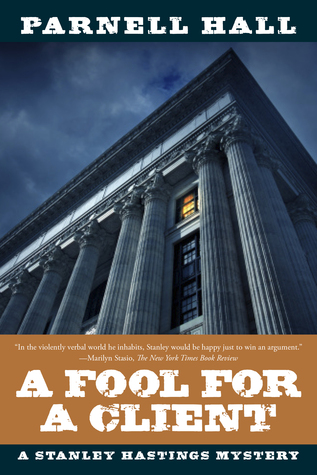
Parnell Hall: A Fool for a Client (Stanley Hastings Mystery #20)

"Tell me about the girl with tits."
"How'd you know about the girl with tits?"
"There's always a girl with tits. She may not have anything to do with the case, but you manage to make her important."
Stanley Hasting's boss, Richard Rosenberg, is in big trouble. Richard's girlfriend, a law clerk, has been murdered and the negligence lawyer is the prime suspect. Richard is the fool because he's decided to represent himself. Why? Because he doesn't trust lawyers: they're sleazy pond scum, and he's proof of that. He wants Stanley's assistance, but it's going to be hard: he was the last person seen with the victim, DNA proves he had sex with her, and his fingerprints are on the murder weapon.

The victim, Jeannie Atkins, was assigned to a global banking trial, which seems unconnected to anything that would have led to murder. She clerked for the judge, and usually judges take a dim view to their assistants being killed. Stanley hopes to find a connection, though, and becomes a regular spectator at the banking trial, which is just as exciting as you think it would be: not at all.

Our hero perseveres through the boredom, though, talking to jurors, alternates, a clerk with romantic ideas of what detectives do, and the long-suffering judge for the trial. He also finds "the girl with tits," Juror Number Twelve. Stanley discovers that she was an alternate promoted after someone else was excused. He procures the address of the excused man and pays a visit - to a dead body.

I've often wanted to see Richard Rosenberg at work, and this book doesn't disappoint. Most of the cases he takes involve trip-and-fall or accidents on city property. Half the people at court are scared of him, and we learn why. He turns down the probable cause hearing and goes straight to trial. He accepts all candidates for the jury without questioning them. He insults the expert witness. He insinuates that no one is telling the truth about when he left the victim's apartment because the security guard slunk off early and his limo driver was padding the time for higher pay. He makes Denny Crane look like a paragon of discretion.

None of this is going to matter, though, because the evidence is against Richard. He was the last person seen with the victim, his bodily fluids were present at the scene, and his fingerprints are on the murder weapon. He has no clue who the murderer is. Stanley's occasional ally, Sergeant MacAuliff, is of the opinion that Richard will only escape jail if he can 'pull an O.J.' and create reasonable doubt.

Will Rosenberg dream up a great strategy, or will he go to prison? Will Stanley find the real killer after all, or go to jail after giving grief to the judge in the banking case one too many times? Read A Fool for a Client to learn the answer to these and other relevant questions, including how often a detective's wife has to explain to her husband what the information he's discovered implies for the case.

I greatly enjoyed the book, but you may need to keep a scorecard for some of the conversations. The repartee zips back and forth very rapidly with few conversation tags. It's still very funny. I was also pleased to see Alice (Stanley's wife) again, who creates order out of her husband's eccentric observations.

Disclosure: I was given an ARC of this book to read and review. You can also see this review at Goodreads.com .

ShareThis